



The most beautiful beaches in the Algarve
Imagine a land where the Atlantic Ocean, powerful and untamed, crashes against cliffs of gold and fire. Picture crystal-clear lagoons hidden behind pale sand dunes, rivaling the most beautiful Caribbean lagoons. Welcome to the Algarve.
Think you already know southern Portugal? Think again. With more than 130 listed beaches, the Algarve is a true kaleidoscope of landscapes. But how do you choose between the wild grandeur of the west and the gentle, almost Mediterranean feel of the east? That is every traveller’s dilemma.
This is where the exclusive selection by Amo-te Olhão comes in.
As passionate travellers deeply in love with this land, each cove, tide and coastal path has been explored. Because the Algarve hides a secret few truly know: beyond its iconic cliffs lies Ria Formosa, a preserved archipelago of lagoons and sandy islands — a natural gem unique in Europe.
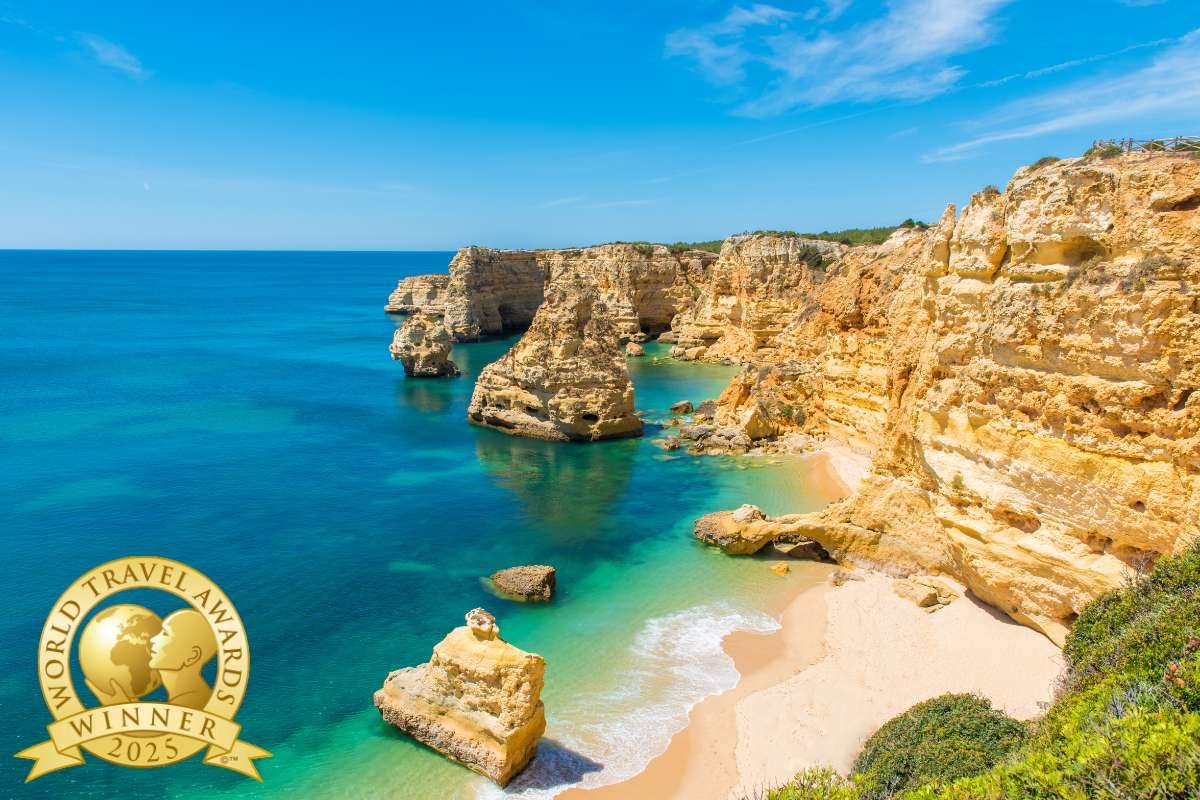
It is no coincidence that in December 2025, at the prestigious World Travel Awards, the Algarve was once again crowned “World’s Best Beach Destination”. An award that simply confirms what has long been known: paradise does exist — and it is right here.
So grab your sunscreen and open your eyes wide. From secret coves accessible at low tide to vast beaches where the horizon seems endless, let yourself be guided to discover a selection of hidden gems that shape the Algarve’s legend.
Ready to find your perfect beach? Follow the guide.
🏆 Top 10 Beaches in the Algarve
Short on time? Here is the very best, carefully selected by Amo-te Olhão so you don’t miss a thing.
- 🥇 Praia da Marinha : Voted the most beautiful beach in the world, famous for its golden cliffs and its iconic “Heart” rock.
- 🥈 Praia de Odeceixe : A unique gem in the north, bordered by the ocean on one side and a river on the other.
- 🥉 Praia da Falésia : 6 km of sand lined with spectacular red cliffs. A must at sunset.
- 4. Praia do Camilo : The most photogenic staircase in the Algarve, leading down to turquoise waters.
- 5. Cacela Velha : One of the most beautiful views in Portugal, overlooking Ria Formosa at the foot of a historic village.
- 6. Ilha de Tavira : The queen of the islands: vast, family-friendly, with a campsite and pine forest.
- 7. Praia da Arrifana : The icon of the wild west coast, a surfer’s paradise and a sunset favourite.
- 8. Praia da Dona Ana : Lagos’ postcard beach, a bay of emerald waters framed by striking rock formations.
- 9. Praia de São Rafael : A natural work of art near Albufeira, famous for its sculpted rock formations.
- 10. Praia dos Três Irmãos : In Alvor, renowned for its secret coves and rocky arches accessible at low tide.
Choosing the right beach in the Algarve by natural areas
Why the Algarve is an exceptional beach destination
The Algarve on Top of the World: A Historic Record at the World Travel Awards 2025
Forget the Maldives. Cross the Seychelles off your list. Stop looking towards the Caribbean. The world’s ultimate beach reference is right here in Europe, at the southern tip of Portugal.
On 6 December 2025, under the spotlight in Bahrain, the verdict of the so-called “Oscars of Tourism” was announced, confirming an unprecedented supremacy. For the fourth time in its history — a feat no other destination worldwide has ever achieved — the Algarve was crowned World’s Best Beach Destination.
This is not just another award, it is true dominance. By winning this coveted trophy at the 32nd edition of the World Travel Awards, the Algarve has outperformed the usual heavyweights such as the Turks and Caicos Islands or Thailand. Following its wins in 2020, 2021 and 2024, the 2025 title seals a truth already known by tourism professionals and seasoned travellers alike: no other region offers such diversity along 200 kilometres of coastline.
Why does the Algarve reign supreme?
This international recognition rewards far more than the visual beauty of golden cliffs or crystal-clear waters. As highlighted by André Gomes, President of the Algarve Tourism Board, this award acknowledges a long-term commitment: preserving unique natural resources while delivering an outstanding visitor experience.
The Algarve is a rare balance between wild nature and easy access. It is the only destination capable of combining:
-
The raw power of the Costa Vicentina for surfers;
-
The secret, photogenic coves of the Barlavento for couples and explorers;
-
The vast sandbanks and protected biodiversity of the Ria Formosa for families.
Already holding 10 European titles over the past decade, the region now reaches a historic milestone. You are not simply visiting a seaside region — you are setting foot in the number one beach destination in the world.
Now that you know why the world envies us, let us show you where to go. Here is our selection of beaches that helped earn those stars.
Costa Vicentina: wild beaches of the Algarve and a surfer’s paradise
Forget everything you thought you knew about southern Portugal. Here, there are no luxury marinas or calm, warm waters. Welcome to the Atlantic edge, where Europe ends and vast open space begins.
The Costa Vicentina is a sanctuary. Part of the Southwest Alentejo Natural Park, it is the most unspoilt stretch of coastline on the mainland. Here, the geology changes dramatically: the fragile ochre cliffs give way to dark, dramatic walls of black schist and greywacke, standing firm against the relentless power of the ocean.
This is the land of raw elements. Wind shapes towering dunes, waves attract the world’s surfing elite, and sunsets take on a mystical intensity. Visiting the west coast means accepting how small you are in the face of nature. It is the Algarve for travellers seeking wide open spaces, vanlife and silence, broken only by the crash of the waves.
From the Alentejo border to Cape St Vincent, this guide leads you through these end-of-the-world beaches, where crowds are rare and beauty is raw and uncompromising.
Praia de Odeceixe (Aljezur)
♥ Favourite
📍 Location: far north-west of the Algarve | 🏄 Surf | 🧸 Family-friendly | 📸 Unique landscape | 🛶 River
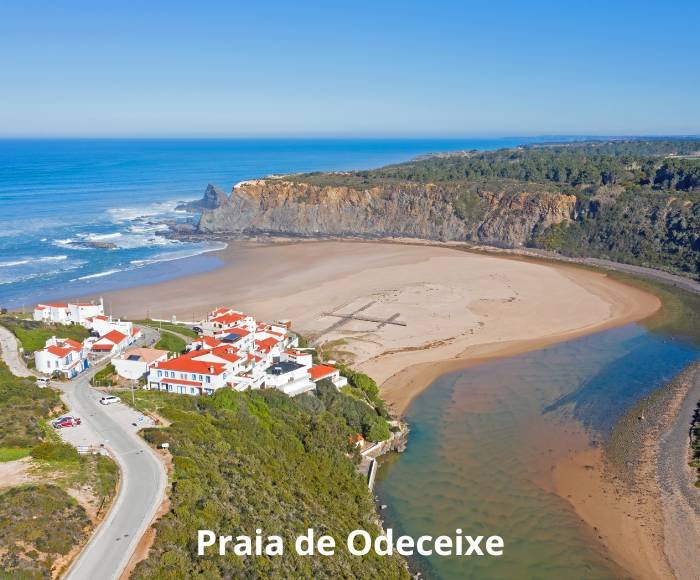
This is the majestic gateway to the Algarve. Seen from above, Praia de Odeceixe looks like a giant horseshoe-shaped sandbar. Its truly unique feature? It is bordered by the Atlantic Ocean on one side and the Seixe River on the other.
It is one of the rare places in the world where you can choose your swimming spot: powerful ocean waves for surfers, or the calm, gentle waters of the river for children. At low tide, shallow lagoons form on the sand, creating perfect natural paddling pools. Don’t miss the view from the lookout at the top of the southern cliff — the contrast between the deep blue of the sea and the emerald green of the river is striking.
-
Amo-te Olhão tip: Rent a kayak and paddle a few kilometres upstream — the silence there is absolute.
- View on Google Maps : click here.
Praia das Adegas (Odeceixe)
📍 Location: just south of Odeceixe (naturist cove) 🍑 Naturism | 🤫 Secluded | 🧘 Peaceful
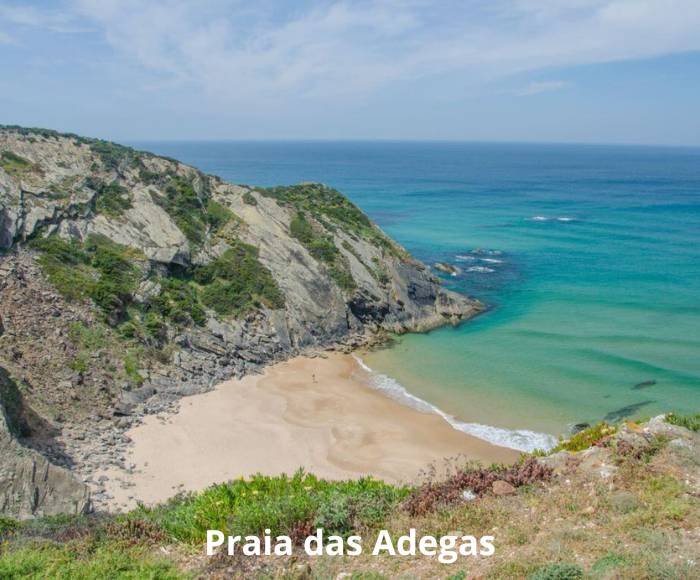
Often overshadowed by the vastness of its neighbour, Praia das Adegas is a discreet cove that has to be earned. Dramatically tucked into the base of a high schist cliff just south of Odeceixe Beach, it offers rare intimacy along this wild coastline. Access is via a wooden staircase winding down the cliff face, or by rounding the rocks at low tide — instantly giving the feeling of entering a secluded sanctuary, cut off from the world.
It is one of the Algarve’s most renowned official naturist beaches, a peaceful haven where freedom reigns. The natural amphitheatre formed by the cliffs is not only a striking backdrop; it also provides effective shelter from northerly winds, creating a microclimate often milder than on the main beach. Here, tourist bustle fades away, replaced by the steady roar of the Atlantic and the raw beauty of dark stone.
-
Amo-te Olhão tip: Perfect when the main beach is too windy, as the high cliffs offer better shelter for relaxed sunbathing.
- View on Google Maps : click here.
Praia da Samoqueira (Aljezur)
📍 Location: north of Aljezur, near Rogil 💎 Hidden gem | 📸 Photogenic | 🦀 Rock pooling
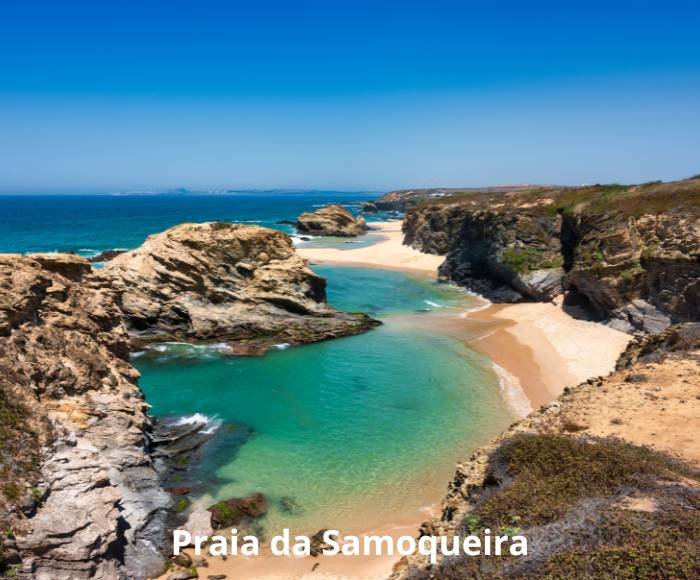
Few travel guides mention it — and that is good news for preserving this hidden treasure. Praia da Samoqueira is a true geological wonder located north of Aljezur. Unlike the vast sandy beaches nearby, it unfolds as a series of small, intimate coves separated by rock formations sculpted by the elements, offering a striking and rugged alternative to more conventional beaches.
The atmosphere here is truly unique, almost prehistoric. As the tide goes out, the area turns into an aquatic maze where mysterious caves and stunning natural pools are revealed. The water, often surprisingly clear for this Atlantic coastline, invites exploration between the rocks. It is a raw, wild setting where nature clearly still holds the upper hand against the ocean.
-
Amo-te Olhão tip: Be sure to visit at low tide to explore the rocky cavities and swim in the lagoons — it is a fascinating natural playground.
- View on Google Maps : click here.
Praia de Vale dos Homens
📍 Location: Rogil (Aljezur) 📉 Challenging access | 🌲 Nature | 📵 Digital detox
To earn it, you must first pay a small physical price: descend a long wooden staircase of 285 steps that winds dramatically down the cliff (save some energy for the climb back up!). Praia de Vale dos Homens is a destination for those who deliberately escape civilisation in search of true isolation. Located near Rogil, it offers a reward worthy of the effort: a wild cove, completely untouched by any construction.
Enclosed by towering walls of black schist that seem to reach the sky, the beach has a raw and intimate atmosphere. However, this beauty is fleeting: at high tide, the strip of sand almost disappears entirely, leaving only the foam crashing against the rock. It is a secret spot, mainly frequented by a handful of knowledgeable locals and solitary fishermen perched on the reefs, far from the summer crowds.
-
Amo-te Olhão tip: Always check the tide times before heading down. Only visit when the tide is going out or low to enjoy the sand safely.
- View on Google Maps : click here.
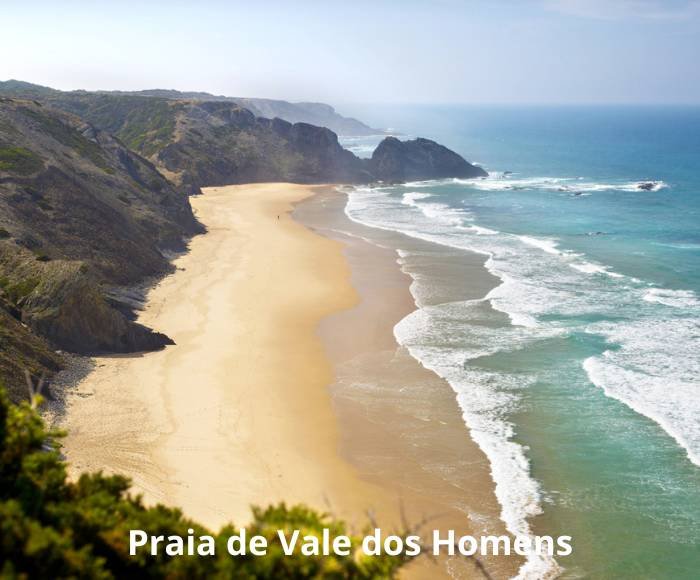
Praia da Carreagem
📍 Location: Rogil (Aljezur) 🦎 Biodiversity | 🚫 Swimming difficult | 👀 Observation
This is a beach that could be described as an “open-air museum”. Praia da Carreagem is not meant for classic swimming or sunbathing on fine sand; it is a raw sanctuary designed for pure contemplation. The natural amphitheatre is spectacular: a striking blend of wild dunes and sharp black rocks plunging into the ocean, creating a dramatic landscape where human presence feels almost insignificant.
The site’s true treasure reveals itself at low tide. The beach then becomes an exceptional spot for observing marine life, highly valued by nature lovers. Numerous rocky cavities trap seawater and turn into natural aquariums, where fascinating ecosystems can be observed without disturbance: crabs, octopus, starfish and anemones thrive here. It is a rare educational and visual experience in the Algarve.
-
Amo-te Olhão tip: The perfect place for a quiet, contemplative walk at the end of the day, far from everything, simply listening to the breath of the Atlantic.
- View on Google Maps : click here.
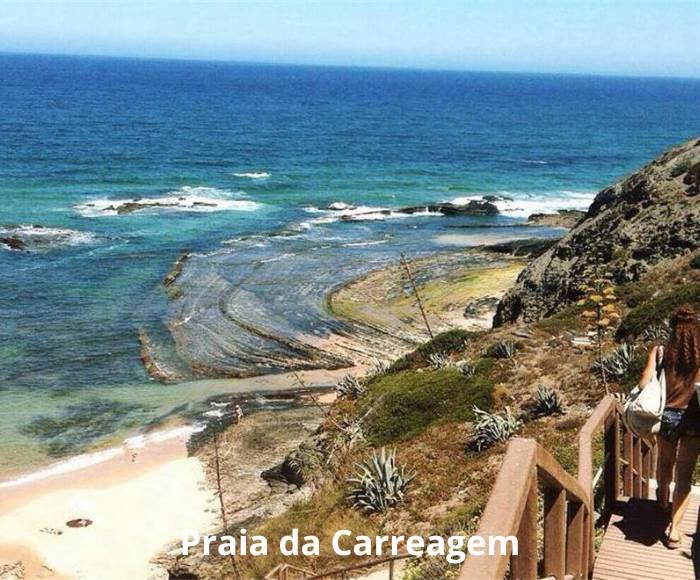
Praia da Amoreira
📍 Location: northern river mouth of Aljezur 🛶 River & Sea | 👨👩👧👦 Family-friendly | 🌊 Dunes
Like its famous neighbour Odeceixe, Praia da Amoreira masters the art of duality by offering the best of two worlds. It is one of the rare places where choice truly matters: on one side, the Atlantic Ocean rolls in with power, delighting surfers; on the other, the Ribeira de Aljezur gently winds its way to the sea, creating a wide lagoon with calm, safe waters — a true paradise for families with children.
Here, the scenery becomes truly monumental. The beach is backed by an immense dune system stretching as far as the eye can see, displaying a rare intensity of colours: the deep black of schist cliffs contrasts with the vibrant green of the vegetation and the electric blue of the water. Access is easy, and a panoramic restaurant perched on the southern cliff allows you to take in this wild beauty at a single glance.
-
Amo-te Olhão tip: Don’t miss the natural pools that form on the northern side (among the rocks) at low tide. The water lingers in the sun and becomes some of the warmest in the region — relatively speaking for the Atlantic!
- View on Google Maps : click here.
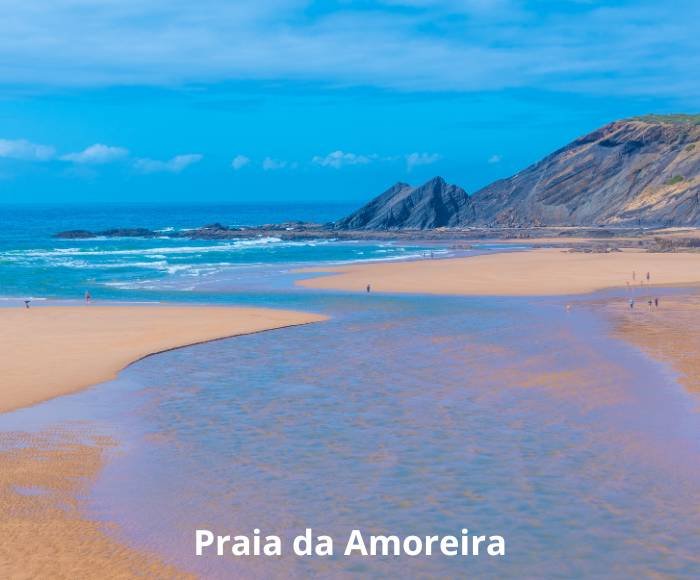
Praia de Monte Clérigo
📍 Location: Aljezur 🏘️ Authentic village | 🏄 Surf school | 🍝 Local dining
This is undoubtedly one of the most iconic and charming images of the Costa Vicentina. A small village of colourful fishermen’s houses seems to tumble down the hillside straight onto the golden sand. Praia de Monte Clérigo offers a cinematic setting that is lively, family-friendly and easily accessible, in contrast with the solitude of nearby beaches.
The atmosphere is typically Portuguese — relaxed and authentic. The beach is vast, allowing everyone to find their own space, but the real spectacle begins at low tide. A wide rocky platform emerges at the northern end, revealing abundant marine life (crabs, anemones, small fish) that delights children and nature lovers alike.
-
Amo-te Olhão tip: Don’t leave without eating at O Zé restaurant. Their grilled fish is exceptional, and the direct view over the waves adds an unforgettable flavour to the meal.
- View on Google Maps : click here.
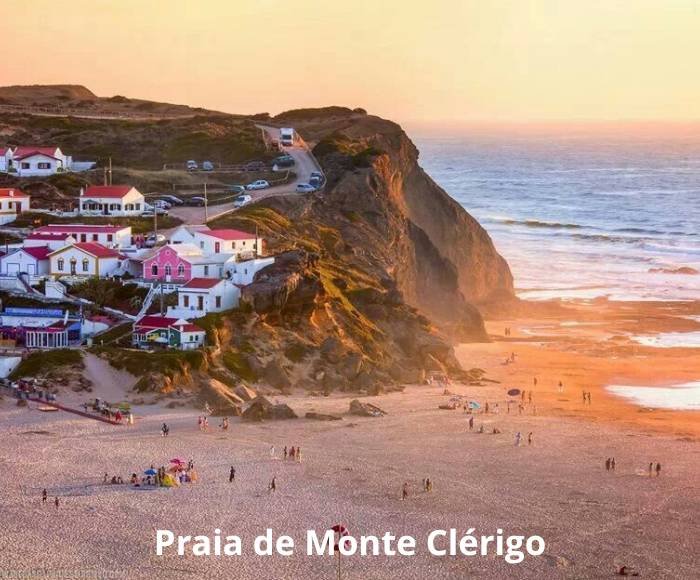
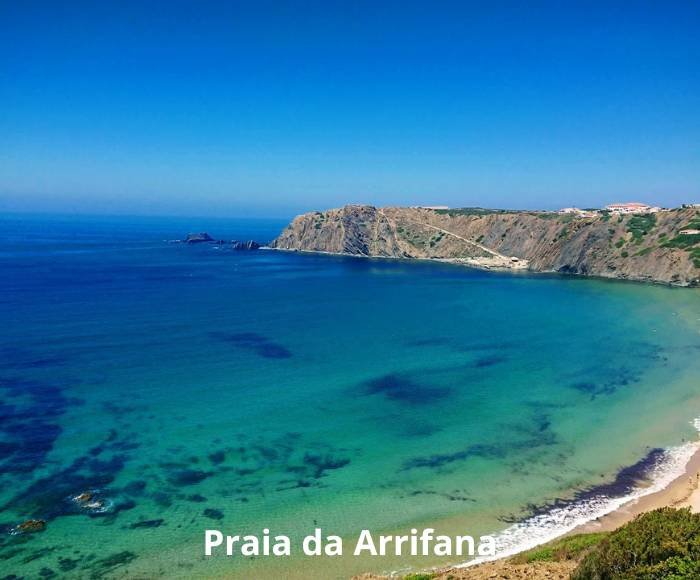
Praia da Arrifana
📍 Location: Aljezur (south) 🏄 Surf spot | 🛡️ Sheltered | 🌅 Sunset
This is undoubtedly the ultimate icon of the west coast — a postcard-perfect image known around the world. Praia da Arrifana stretches out as a long, perfectly crescent-shaped bay, dramatically sheltered from prevailing northerly winds by towering cliffs of black schist. Its eternal guardian? The majestic Pedra da Agulha (Needle Rock), a vertical monolith rising from the ocean on the southern horizon, giving the landscape a truly dramatic character.
The atmosphere here is vibrant, sporty and effortlessly cool. It is the gathering place of a passionate surf community, often seen climbing the steep slope in wetsuits, boards under their arms. As evening falls, the magic begins: vans park on the clifftops to watch the show, and an incredible golden light floods the bay, creating one of the most moving sunsets in the Algarve.
-
Amo-te Olhão tip: Pay attention to parking! Do not try to park at the bottom (strictly reserved for residents). Park on the plateau above and walk down, or take advantage of the electric shuttle buggies often available in summer.
- View on Google Maps : click here.
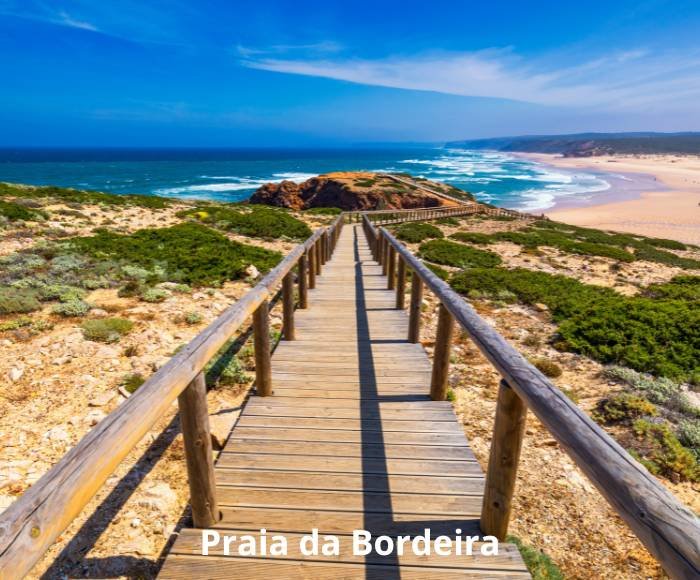
Praia da Bordeira
📍 Location: Carrapateira dunes | Giant dunes | 🌬️ Kitesurfing | 🪵 Boardwalks
Here, the sand seems to stretch endlessly towards the horizon. Praia da Bordeira is famous for its monumental dune field — undoubtedly one of the largest in the Algarve — which must be crossed like a small desert expedition before finally reaching the ocean. Near the access point, a small river often forms a shallow, warm-water lagoon, offering a calm and gentle alternative to the ocean waves.
This is a beach with a strong character, highly exposed to the wind, making it an undisputed paradise for kitesurfers and lovers of raw nature. It offers breathtaking open landscapes where you truly feel tiny in the face of the elements. Even if you do not surf, the sight of colourful kites dancing above the whitecaps in this grand setting is worth the trip on its own.
-
Amo-te Olhão tip: Follow the wooden boardwalks built along the cliffs. They offer some of the most beautiful viewpoints in the region and allow you to admire the vastness of the site without walking through soft sand.
- View on Google Maps : click here.
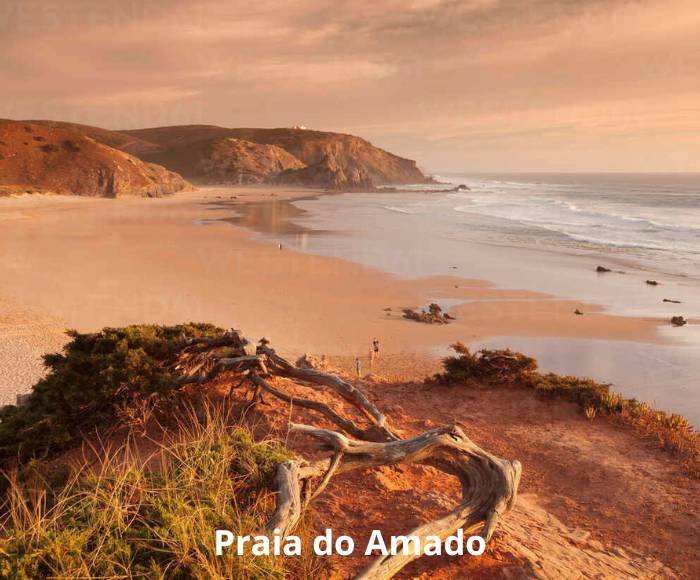
Praia do Amado
📍 Location: Carrapateira (south) 🌈 Red rocks | 🏄 Surf schools | 🚐 Vanlife
If the Costa Vicentina were to choose a capital, it would undoubtedly be Praia do Amado. This beach is a spectacular geological anomaly that delights photographers: here, the colour palette ignites, with cliffs shifting to deep reds and ochres, creating a striking contrast with the usual dark grey schist. It is a vast, generous beach — a true natural amphitheatre open to the Atlantic.
The energy here is unique, both vibrant and effortlessly cool, with a distinctly cosmopolitan feel. The site is home to several well-known surf schools, making it the perfect spot to learn to surf or simply watch experienced surfers in action. Even without a board, people come to soak up the atmosphere of freedom and vanlife, and to watch the endless dance of the waves.
-
Amo-te Olhão tip: This is one of the best places along the entire coast to watch the sunset, simply sitting on your car roof or perched on the red rocks facing the horizon.
- View on Google Maps : click here.
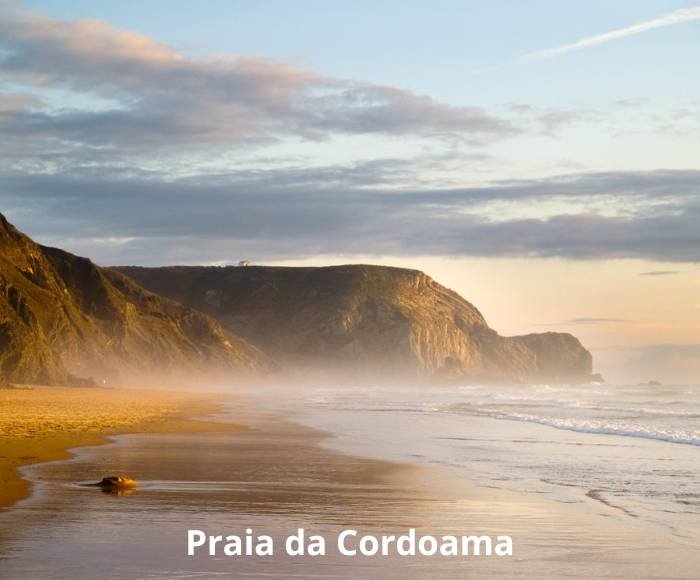
Praia da Cordoama
📍 Location: Vila do Bispo 🌫️ Mystical | 🦅 Paragliding | 🌑 Black rocks
Here, you enter the wildest and most monumental territory of Vila do Bispo. Praia da Cordoama is a vast stretch of sand that seems endless, naturally connected to neighbouring Castelejo Beach at low tide. The scenery is overwhelmingly majestic: black schist cliffs rise to more than 100 metres high, forming an imposing wall facing the ocean.
The atmosphere is distinctive, often wrapped in sea mist in the morning, giving the landscape a mystical feel — almost Scottish or Irish — far removed from Mediterranean clichés. At low tide, the beach becomes immense, a true desert of sand and foam, perfect for long, solitary and introspective walks, with only the powerful sound of the surf for company.
-
Amo-te Olhão tip: Gain some height! Be sure to visit the Miradouro do Cordoama viewpoint just above the beach. The plunging view over this rugged coastline is simply breathtaking.
- View on Google Maps : click here.
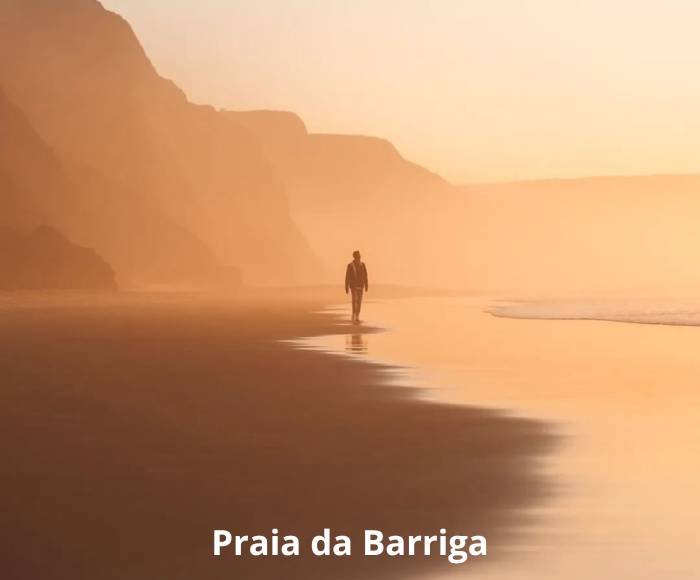
Praia da Barriga
📍 Location: Vila do Bispo (difficult access) 🦖 Jurassic | 🤫 Deserted | 💎 Reflections
Immediately neighbouring Cordoama, Praia da Barriga lies quite literally at the end of a long, green valley, offering a dramatic finale to the road. It is an end-of-the-world beach, dominated by gigantic cliffs that seem to weep continuously: freshwater often seeps from them, creating fascinating mirror-like reflections on the dark and golden sand at low tide.
This is a silent beach, almost intimidating in its raw beauty and total isolation. The atmosphere feels deeply primitive; between the mist, the dark rock and the thunder of the waves, one could almost expect a dinosaur to emerge from behind a boulder. A place to feel utterly alone in the face of nature.
-
Amo-te Olhão tip: It can be reached on foot from Cordoama at low tide (much easier and safer than driving along the rough track). Be careful, though: don’t get caught by the rising tide, as the return route could be cut off.
- View on Google Maps : click here.
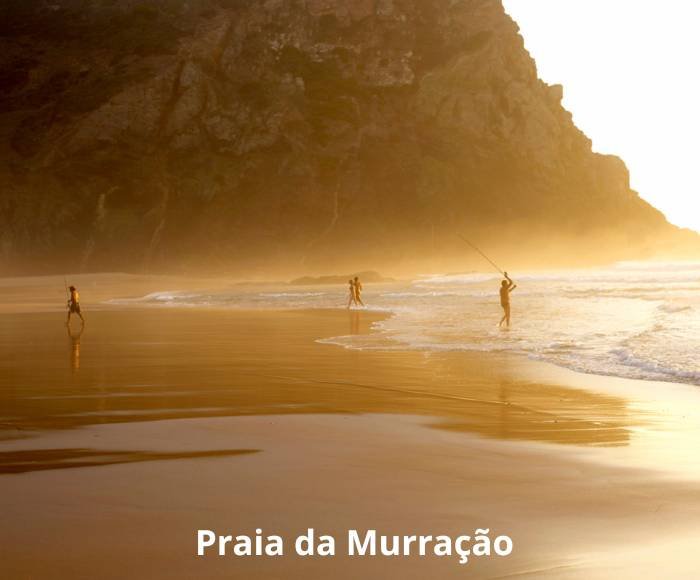
Praia da Murração
📍 Location: Vila do Bispo (via the “Jóia da Vicentina” track) 💎 Hidden gem | 🧘 Off the beaten path | 🐢 Wildlife
This is our ultimate hidden gem for adventurous souls. Praia da Murração stands out as one of the very few beaches on the Costa Vicentina where the cliffs miraculously open up, allowing the track to descend almost to sea level. It is a true open-air geological jewel, offering a striking contrast where dramatic black schist meets veins of red and orange limestone, creating a unique colour palette.
Far from the civilised world and often out of mobile range, the sense of calm here is absolute. The water is incredibly clear — often clearer than elsewhere along the Atlantic coast — inviting you to swim in this wild setting. It is the perfect spot to completely disconnect and feel alone in front of the vast ocean, surrounded only by the grandeur of nature.
-
Amo-te Olhão tip: Take care — the access track requires slow and cautious driving (avoid sports cars or very low vehicles). This is the price to pay to reach this hidden paradise.
- View on Google Maps : click here.
Western Barlavento: iconic coves and beaches of the Algarve
Here, we cross a threshold — both literally and symbolically. Rounding the mythical Cape St Vincent, the south-western tip of Europe, the ocean begins to calm slightly and the geology starts its spectacular transformation. The dark, hostile cliffs of the west gradually fade, giving way to the white and golden limestone that would make the Algarve famous worldwide.
This is a fascinating transition zone, land of great navigators and ancient maritime legends. From the fortress of Sagres to the walls of Lagos, every cove tells a story of conquest and piracy. The wind still blows strong here — the famous “Nortada” — but the water becomes increasingly clear, shifting from deep navy blue to bright turquoise.
The Western Barlavento strikes a perfect balance between wild nature and seaside charm. This is where rock sculptures begin: natural arches, sea caves and stone pillars rise from the water like sentinels. It is a coastline of contrasts, capable of offering world-class windsurfing spots just metres away from peaceful lagoons sheltered by high ochre cliffs.
From mystical Sagres to the Alvor estuary, this guide takes you to beaches where Portugal’s history meets the raw beauty of the elements, between vertiginous cliffs and golden sands.
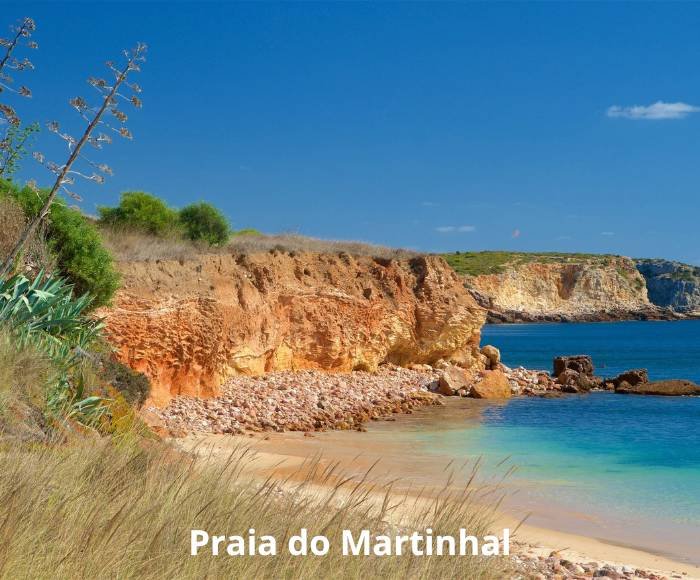
Praia do Martinhal (Sagres)
📍 Location: just east of Sagres | 🌬️ Windsurfing | 👨👩👧👦 Family-friendly | 🏨 Resort
This is Sagres’ chic and sporty beach. Located just east of the fishing harbour, Praia do Martinhal is a wide bay of fine sand with striking turquoise waters, famous for its discreet luxury resort that blends seamlessly into the surrounding landscape. While less exposed to the huge waves of the west coast, it remains a favourite playground of the “Nortada” — the powerful northerly wind — making it one of Europe’s best windsurfing spots.
Despite the frequent wind, the atmosphere is very family-friendly, thanks to shallow, crystal-clear waters. Offshore, the limestone islets (Ilhotes do Martinhal) rise from the sea like white sentinels, creating a beautiful seascape that contrasts with the arid land behind. It is a hybrid beach that successfully combines wild, elemental surroundings with a high level of comfort.
-
Amo-te Olhão tip: The offshore islets are home to rich marine life. This is an excellent spot for snorkelling (and scuba diving), easily reached by renting a kayak on the beach.
- View on Google Maps : click here.
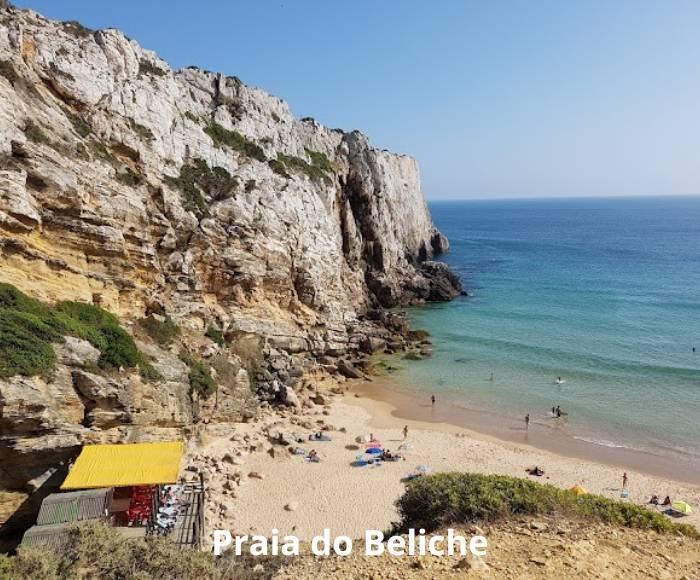
Praia do Beliche (Sagres)
📍 Location: between Sagres and Cape St Vincent | 🛡️ Sheltered | 🌅 Sunset | 🏄 Bodyboarding
This is a stunning cove nestled between vertiginous cliffs rising over 40 metres high, located just before reaching the iconic Cape St Vincent lighthouse. Praia do Beliche is often the locals’ secret refuge when the wind blows too hard elsewhere: its south-west orientation and high, curved rock walls provide valuable shelter from the “Nortada”. Access is via a long staircase that immediately immerses you in an end-of-the-world atmosphere.
The setting is grand, almost theatrical. In the late afternoon, golden light ignites the orange rock, creating a striking contrast with the deep, cool blue of the Atlantic. It is a favourite beach for bodyboarders thanks to its fast, hollow waves, but also for those seeking quiet relaxation in a monumental landscape, far from classic seaside resorts.
-
Amo-te Olhão tip: At low tide, explore the natural caves carved into the base of the cliffs. This is also one of the most magical spots to wait for the sunset before heading back up to the lighthouse.
- View on Google Maps : click here.
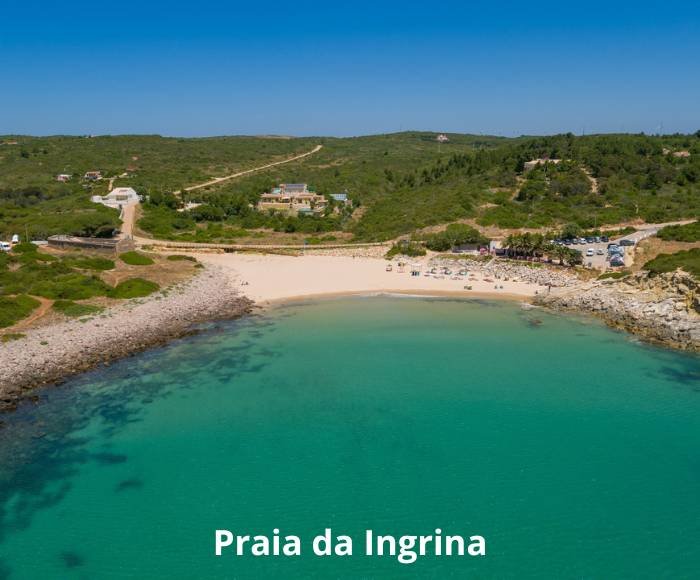
Praia da Ingrina (Vila do Bispo)
📍 Location: Raposeira | 🐚 Shells | 🛶 Kayaking | 🍽️ Beach restaurant
Far from the vast sandy stretches typical of the west coast, Praia da Ingrina reveals itself as a tiny, shell-shaped bay — a true “pocket beach” that feels intimate and welcoming. Here, the scenery changes: towering cliffs soften into low rock formations, and the ocean is often calm and crystal-clear, sometimes evoking the gentle feel of the Mediterranean. It is a peaceful place where time seems to stand still, with an atmosphere frozen in a touch of 1980s nostalgia.
This is a discreet destination cherished by local families and amateur divers. The absence of strong waves allows for safe, relaxed swimming, while the rich, shallow seabed is easily explored with nothing more than a mask and snorkel. The surrounding rocks also offer pleasant walks to observe seabirds, far from any crowds.
-
Amo-te Olhão tip: The restaurant “O Sebastião”, literally set on the sand, serves exceptionally fresh seafood. It is the perfect spot for a seaside lunch break, with your feet almost in the water.
- View on Google Maps : click here.
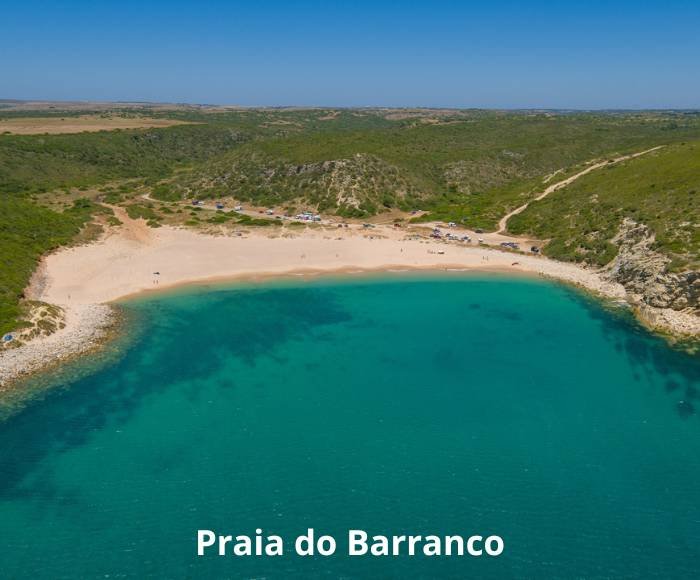
Praia do Barranco (Raposeira)
📍 Location: dirt track from Raposeira | ☮️ Hippie vibe | 🤫 Wild | 🚐 Vanlife
Attention — this is a true hidden gem for adventurous souls! Praia do Barranco (not to be confused with its namesake near Albufeira) is the secret refuge of freedom lovers and the Algarve’s last hippies. Accessible only via a long, bumpy dirt track that naturally deters mass tourism, this wide and wild bay is tucked between green hills, offering complete isolation far from asphalt and concrete.
Unlike many neighbouring west coast beaches often swept by strong winds, this bay is miraculously sheltered, with water frequently as smooth as glass and a near-tropical turquoise colour. Silence reigns here, broken only by birdsong and the discreet presence of a few colourfully painted vans parked nearby. It is the perfect place for long, peaceful swims in calm water, while still enjoying a fully Atlantic setting.
-
Amo-te Olhão tip: Nudism is common and generally accepted here. Be sure to bring water and food, as there are no facilities nearby. Disconnection is guaranteed.
- View on Google Maps : click here.
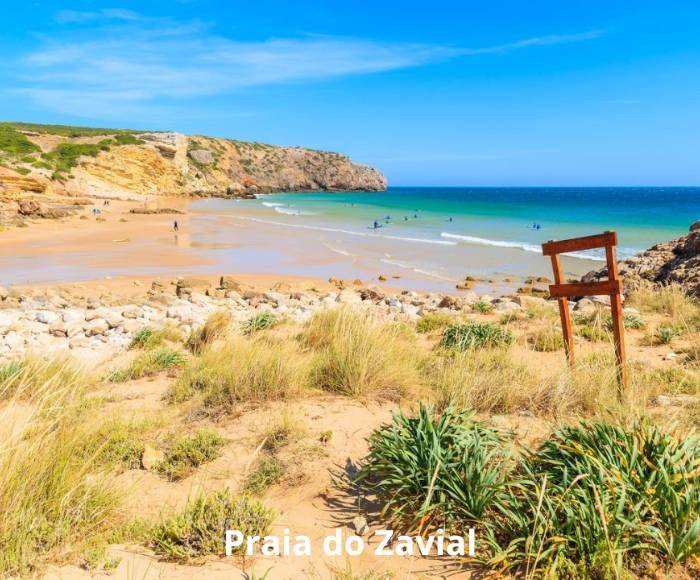
Praia do Zavial (Vila do Bispo)
📍 Location: Raposeira | 🏄 Surf | 🍑 Naturism (partial) | 🏛️ Ruins
Immediately neighbouring Ingrina but on a much grander scale, Praia do Zavial unfolds majestically at the mouth of a wide, green valley. This beach offers a rare duality that suits every type of traveller: its western section, close to amenities, is friendly and family-oriented; while the eastern end, tucked beneath steep golden cliffs, becomes a wild sanctuary — more intimate and traditionally associated with naturism.
Beyond its golden sand, Zavial is a legend among insiders. In winter, it produces a fast and powerful barrel wave that rivals the best spots on the west coast, attracting the local surfing elite. The site is also steeped in history: the rocky headlands framing the beach still bear the remains of ancient military watchpoints, recalling a time when these isolated coves had to be defended against pirate raids.
-
Amo-te Olhão tip: Look up towards the cliff on the right: the ruins of Fort Zavial (17th century) are still visible. A short walk leads up to them, offering a superb panoramic view over the bay.
- View on Google Maps : click here.
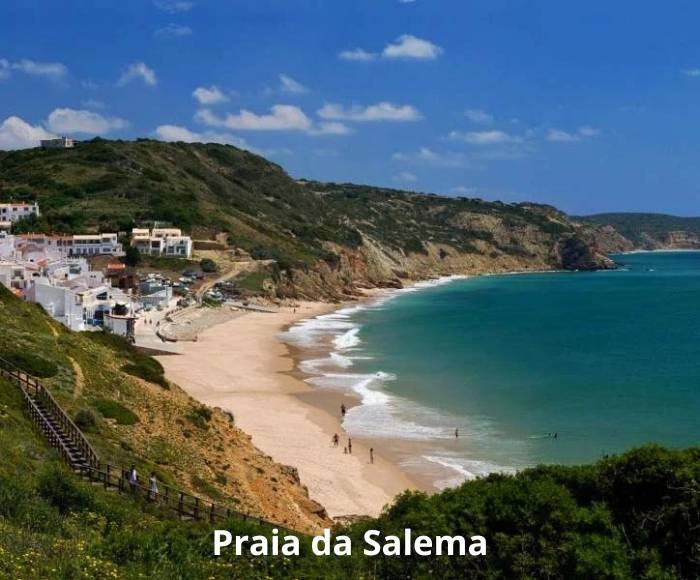
Praia da Salema (Vila do Bispo)
📍 Location: village of Salema | 🦖 Dinosaurs | 🎣 Fishermen | 👨👩👧👦 Family-friendly
It is one of the few villages in the Algarve that has managed to resist overdevelopment while remaining a popular seaside destination. Praia da Salema embodies the soul of authentic Portugal: a wide stretch of golden sand where colourful fishing boats are still pulled up onto the beach after the tide, side by side with holidaymakers’ towels. The village, with its cobbled lanes and whitewashed houses, gently slopes down to the ocean, offering a charming seaside promenade.
But Salema hides a secret far older than its maritime traditions. It is a true open-air palaeontological site. On the rocky slabs bordering the beach, you can spot perfectly preserved dinosaur footprints dating back 140 million years. This makes it an ideal beach for families, combining calm, supervised waters with a life-size natural history lesson that never fails to fascinate children.
-
Amo-te Olhão tip: Go treasure hunting! Look for dinosaur footprints on the yellow rock platform at the western end of the beach (at low tide). It is one of the very few places in the world where you can literally walk in the footsteps of giants.
- View on Google Maps : click here.
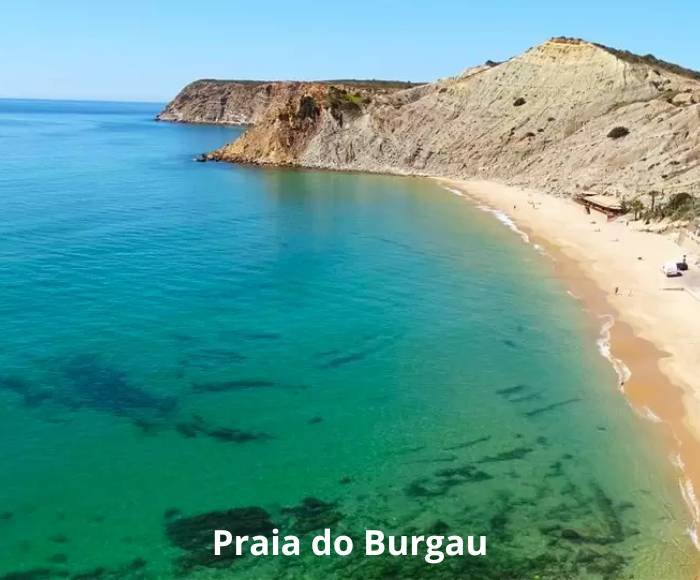
Praia do Burgau (Vila do Bispo)
📍 Location: village of Burgau | 🇬🇷 Santorini-style | 🍝 Dining | 👨👩👧👦 Family-friendly
Affectionately nicknamed the “Santorini of the Algarve”, Praia do Burgau is a living postcard. This small fishing village, with its whitewashed houses and blue shutters, cascades down the cliffs to a small cove of golden sand. The atmosphere is truly unique — delightfully vintage and laid-back — evoking the authentic Algarve of the 1980s, before mass tourism arrived.
The beach itself is a sheltered bay framed by limestone cliffs, making it especially popular with families thanks to its safe swimming conditions. At high tide, the strip of sand becomes much narrower, bringing beachgoers closer to the café terraces lining the seafront and creating a lively, convivial atmosphere where you can move from towel to table in just a few steps.
-
Amo-te Olhão tip: Don’t miss a drink at the famous “Beach Bar Burgau” at the end of the day. It’s one of the rare places where you can sip a cocktail literally above the sand while watching the fishing boats come back in.
- View on Google Maps : click here.
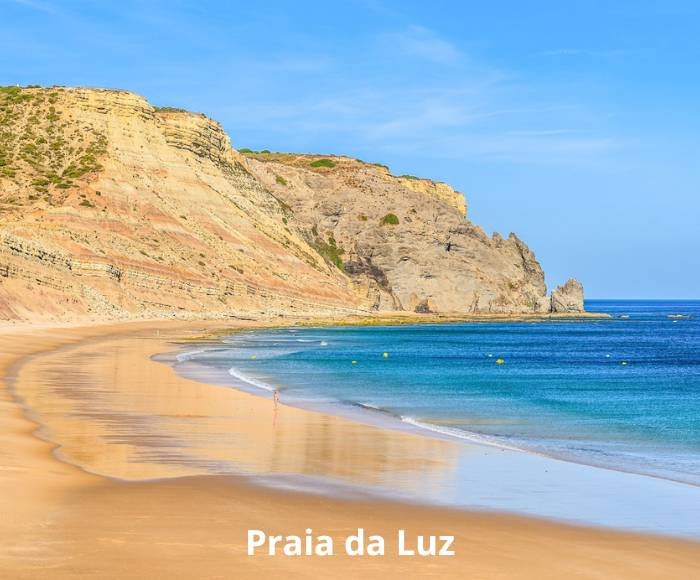
Praia da Luz (Lagos)
📍 Location: Vila da Luz | 🌋 Black rock | 🇬🇧 Cosmopolitan | 👨👩👧👦 Family-friendly
Once a fishing village and now a cosmopolitan seaside resort, Praia da Luz is known for its elegant atmosphere and its beautiful paved promenade (“Calçada”), lined with palm trees and seaside terraces. It is a wide, reassuring beach, highly appreciated for its fine sand and calm, supervised waters, making it a favourite choice for families and British residents alike.
Its most distinctive feature is impossible to miss: the Rocha Negra (Black Rock), an imposing dark volcanic outcrop at the eastern end of the beach, creating a striking contrast with the golden limestone and ochre cliffs typical of the region. It is a lively beach where many water sports are practised, and where history is never far away, with the remains of Roman baths visible just behind the promenade.
-
Amo-te Olhão tip: Climb to the top of Rocha Negra (the trail is accessible from the eastern end of the beach). The panoramic view over Luz Bay on one side and the vast open ocean on the other is spectacular.
- View on Google Maps : click here.
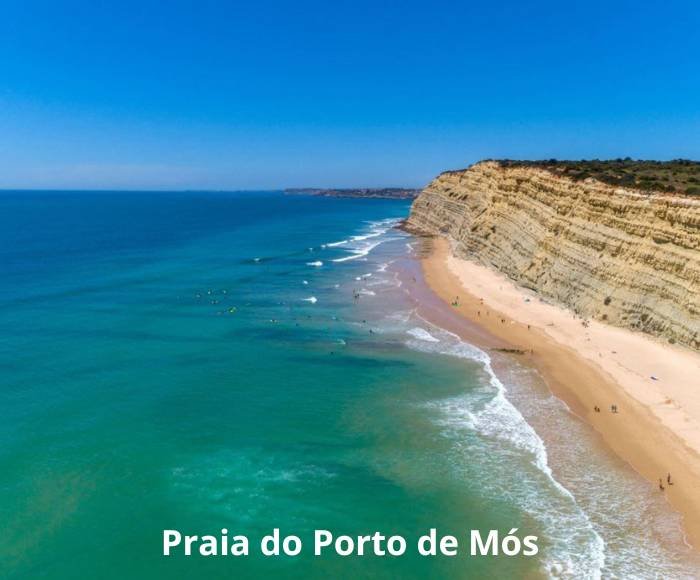
Praia do Porto de Mós (Lagos)
📍 Location: Lagos (south-west) | 🏄 Surf & Relaxation | 🧱 Clay cliffs | ♿ Accessible
It is the second largest beach in the Lagos area after Meia Praia, but with far more character. Praia do Porto de Mós stands out for its long golden and whitish clay cliffs framing a wide stretch of sand. Unlike the enclosed coves closer to the city centre (such as Dona Ana), the horizon here is wide open, creating a strong sense of space and freedom, even in the height of summer.
This is a perfect hybrid beach: exposed enough to offer good waves for beginner and intermediate surfers, yet gentle enough for families. Access is particularly easy (parking at sea level, no steep staircases), making it one of the most accessible beaches in the area for people with reduced mobility or pushchairs.
-
Amo-te Olhão tip: One of the best spots for a romantic dinner by the sea. The two restaurants set directly on the beach offer uninterrupted views of the sunset, with no visual obstacles.
- View on Google Maps : click here.
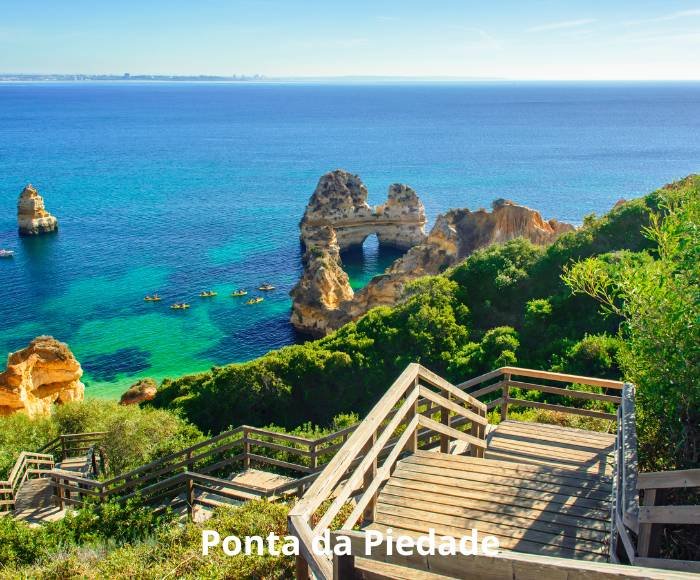
Ponta da Piedade (Lagos)
♥ Favourite
📍 Location: Lagos (southern tip) | 🌟 Iconic | 🛥️ Boat trips | 📸 Photogenic | 🪜 Staircases
It is not a “beach” in the traditional sense where you lay down your towel, but ignoring this place would be a crime. Ponta da Piedade is the Algarve’s ultimate masterpiece — a magical headland where erosion has sculpted golden limestone into monumental arches, isolated stacks and hidden grottos. The water is an unreal emerald green, so clear that every rock on the seabed is visible. This is the postcard image that has travelled the world.
The site can be experienced in two ways: from above, via wooden walkways offering vertiginous views over the cliffs; or from below, by descending the long staircases (more than 180 steps) to reach the water’s edge, right in the heart of this stone labyrinth. It is a naturally baroque setting of breathtaking beauty that alone justifies a trip to the region.
-
Amo-te Olhão tip: To experience the full magic, see this site from the sea. Rent a small fishing boat or a kayak from Lagos Marina — it is the only way to sail under the natural arches and enter the caves known as the “Cathedrals”.
- View on Google Maps : click here.
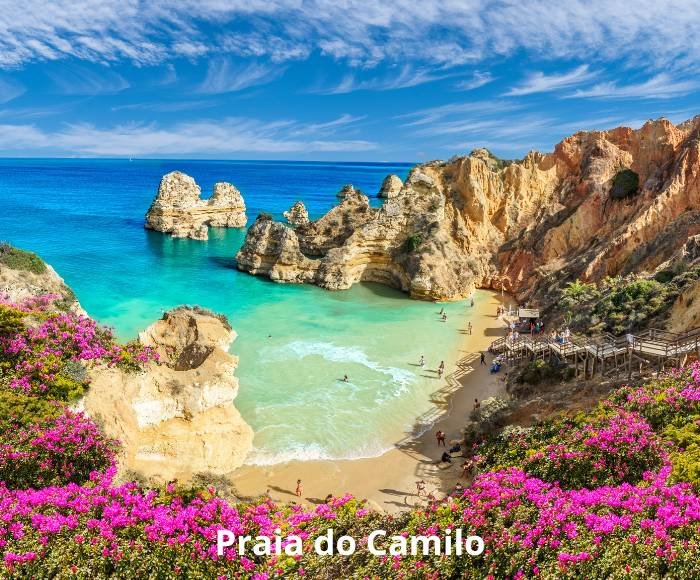
Praia do Camilo (Lagos)
♥ Favourite
📍 Location: Lagos (south) | 🪜 200 steps | 📸 Insta-famous | 🐠 Snorkelling | 🏖️ Tunnel
This is undoubtedly one of the most photographed beaches in Europe — and for good reason. To reach the sand of Praia do Camilo, you must descend a majestic wooden staircase of more than 200 steps, offering breathtaking, plunging views over the turquoise ocean. At the bottom lies a true gem: two small golden-sand beaches connected by a hand-carved tunnel through the ochre rock.
The water here is exceptionally calm and crystal-clear, sheltered from the wind by high cliffs that encircle the cove like a natural amphitheatre. Scattered rock formations in the water create a stunning setting and fascinating snorkelling spots. Intimate by nature, the beach is also a victim of its own popularity in summer — it must be approached with good timing.
-
Amo-te Olhão tip: Arrive very early in the morning (before 9:30 am). Not only to secure space for your towel, but also because the east-facing cliffs cast shade over the sand fairly early in the afternoon.
- View on Google Maps : click here.
Praia da Dona Ana (Lagos)
♥ Favourite
📍 Location: Lagos (south) | 🏆 World-famous | 🏨 Hotels | 🏊 Swimming | 🧱 Golden cliffs
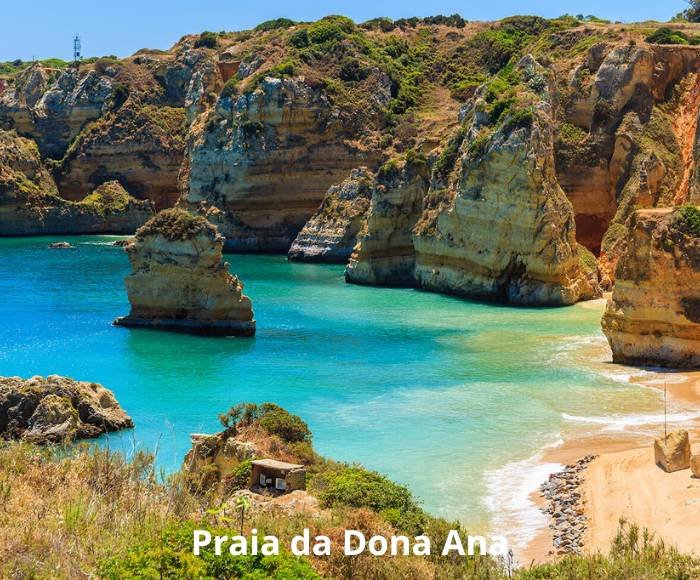
This is the absolute benchmark — the beach that has graced the covers of countless travel magazines. Praia da Dona Ana is an iconic bay, framed by spectacularly eroded golden cliffs that plunge into intensely emerald waters. Unlike Camilo, the beach is wider (it has been replenished with sand), offering more space to welcome the many admirers who visit each year.
The setting is idyllic: isolated rock stacks offshore break the waves, creating a giant natural pool that is calm and safe, ideal for swimming. Although the backdrop includes tourist buildings (hotels), the raw beauty of the cliffs and the colour of the water quickly make the urban environment fade away once you look towards the horizon.
-
Amo-te Olhão tip: Don’t forget your mask and snorkel! The many submerged rocks around the limestone pillars are full of small fish. It’s a natural aquarium that is very easy to explore, even for beginners.
- View on Google Maps : click here.
Praia dos Estudantes (Lagos)
📍 Location: Lagos (city centre) | 🌉 Roman bridge (arch) | 📸 Postcard-perfect | 🏖️ Tunnels
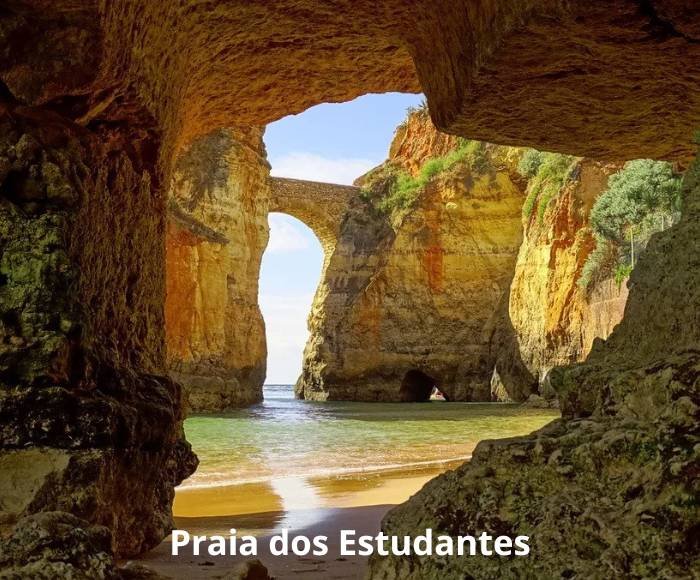
This is one of the Algarve’s most viral images. Praia dos Estudantes (Students’ Beach) is a small, sheltered cove, famous for its monumental stone arch — a remnant of the bridge from the former Pinhão fortress — which connects the cliff to an isolated rock rising from the sea. This theatrical setting has made it a pilgrimage site for photographers from all over the world.
Located just a short walk from Lagos’ historic centre, it is linked to its neighbouring beach (Praia da Batata) by a hand-carved tunnel cut directly into the rock. The beach has fine sand and is very well protected from the wind, with water that is often remarkably calm. Do note, however, that at high tide much of the sand disappears, making the space very intimate — and sometimes quite tight in summer.
-
Amo-te Olhão tip: For the perfect photo of the arch with its reflection in the water, be sure to come at low tide or mid-tide. This is also the only time you can walk beneath the arch without getting wet.
- View on Google Maps : click here.
Praia dos Pinheiros (Lagos)
📍 Location: Lagos (Ponta da Piedade) | 🤫 Secret spot | 🍑 Naturism | 🧗 Challenging access
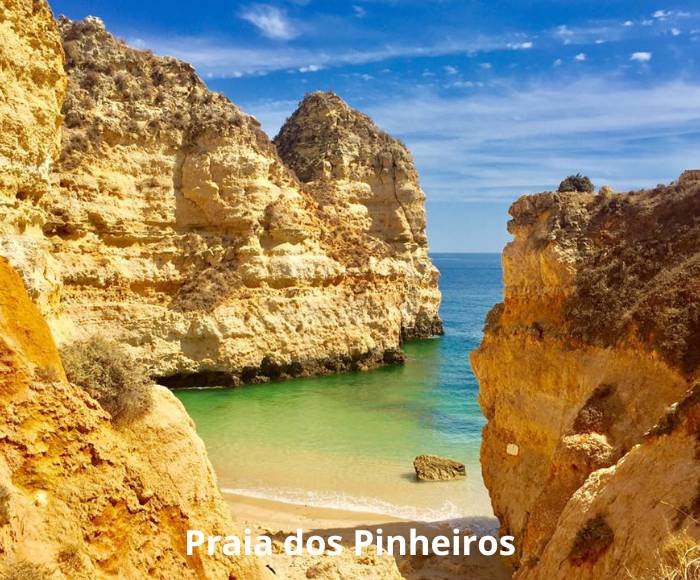
This is one of Lagos’ best-kept secrets, often overlooked by the crowds flocking to Camilo or Dona Ana. Praia dos Pinheiros takes its name from the umbrella pines lining the top of the cliffs. It is a wild cove, tucked away at the bottom of a deep ravine, offering a true sense of isolation despite being just minutes from the city centre.
Access is a small adventure in itself: you must follow a narrow, steep path carved into the rock (there are no built staircases here). This relative difficulty naturally filters visitors, ensuring complete tranquillity at the bottom. It is a peaceful sanctuary with calm, clear waters, which has naturally become a favoured spot for naturism thanks to its discretion.
-
Amo-te Olhão tip: Take care on the descent! Wear proper shoes (avoid flip-flops), as the path can be slippery. Once at the bottom, it’s paradise — but don’t forget to bring water, as there are absolutely no facilities.
- View on Google Maps : click here.
Praia do Canavial (Lagos)
♥ Favourite
📍 Location: Lagos (west) | 🤫 Secret spot | 🧘 Absolute calm | 🧱 Wild cliffs
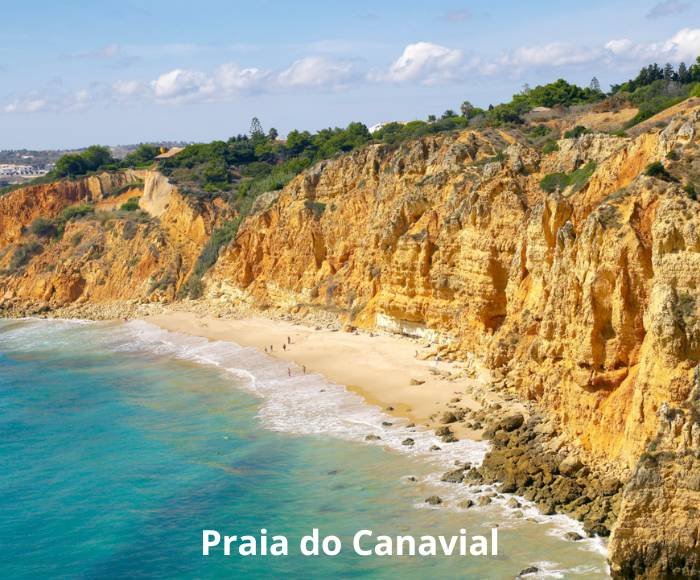
This is the quiet shadow of the superstar “Praia do Camilo”. The two beaches are literally neighbours, separated by a single cliff, yet the contrast is striking: while Camilo is often crowded, Praia do Canavial remains an almost deserted haven of peace, even in the height of August. Here, there are no photogenic wooden staircases — just a discreet path winding through wild vegetation down to the ocean.
Once at the bottom, the reward is immense: a long strip of golden sand backed by towering ochre cliffs, bathed in crystal-clear water. This is the beach for insiders, for those seeking the raw beauty of Lagos without the tourist bustle. The complete absence of facilities (no bar, no sunbeds) guarantees absolute tranquillity, broken only by the sound of the surf.
-
Amo-te Olhão tip: Be aware — this is a very narrow beach! Always check the tide times: at high tide, the beach almost completely disappears. Visit at low tide to fully enjoy the space.
- View on Google Maps : click here.
The Heart of the Algarve: Sea Caves and Golden Cliffs
Welcome to the true sanctuary of the “Gold Coast”. It is here, along the coastline between Portimão, Lagoa and Albufeira, that the Algarve reveals its most spectacular and iconic face. The rock palette shifts once again to warm, vibrant tones — ochre, orange and gold — sculpted over millennia into a fascinating geological lace.
This is the land of superlatives and world-famous icons. You will find here the highest concentration of natural arches, sea stacks and marine caves — including the legendary Benagil Cave — anywhere in Europe. The ocean is often calmer, leaving behind the tempests of the North Atlantic to offer deep, crystal-clear emerald waters, a true invitation to swimming and nautical exploration.
The Heart of the Algarve is a territory of striking contrasts. It can reveal secret, deserted coves accessible only by sea or through hand-carved tunnels, just a few kilometres away from vast, lively beaches that define the energy of the Portuguese summer. This is where nature has shown its greatest creativity, shaping stone cathedrals rising above the waves.
From the Alvor estuary to the endless red cliffs of Praia da Falésia, this journey leads you through legendary places. Get ready to discover dreamlike landscapes, where every corner hides a natural wonder and where sunlight plays with golden rock like nowhere else.
Praia dos Três Irmãos (Alvor)
📍 Location: Alvor (Portimão) | 🪨 Iconic rock formations | 🕵️ Walk-in caves | 📸 Photogenic | 🌅 Sunrise
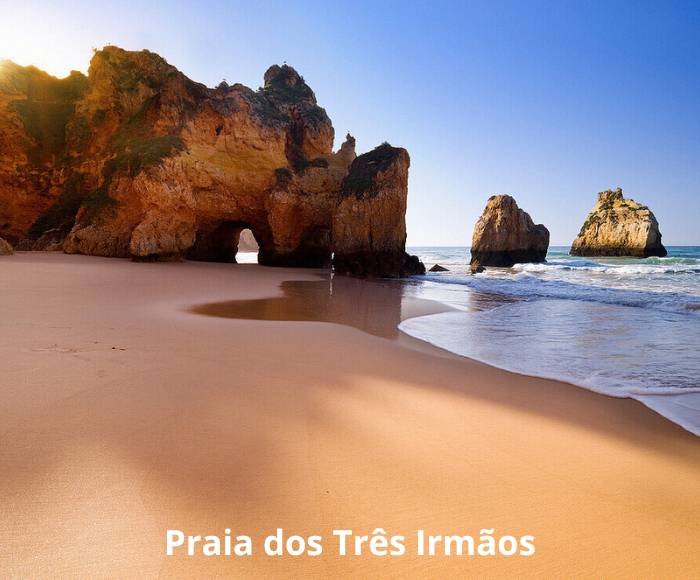
Its name means “Three Brothers Beach”, referring to the three iconic rock formations rising proudly from the water. Praia dos Três Irmãos is a true open-air geological labyrinth. Located at the eastern end of the long Alvor beach, it offers a unique exploration experience: a succession of small, secret coves connected by natural arches and narrow passages carved into the ochre rock.
This beach is especially popular with photographers and families thanks to its playful character. At low tide, you can move from one cove to another as if wandering through rooms of a natural palace. The water is crystal-clear, and the rocks break the swell, creating calm swimming areas. It is also one of the rare spots along the south coast where you can watch the sun rise through the rock arches.
-
Amo-te Olhão tip: Don’t stop at the first cove! Continue walking east through the rocks (at low tide). You’ll discover “Prainha”, a stunning hidden cove with a lift built into the cliff.
- View on Google Maps : click here.
Praia do Submarino (Alvor)
📍 Location: Alvor (Prainha area) | ⚓ Unusual rock formation | 🕵️ Secret cove | 🐠 Snorkelling | 📸 Curiosity
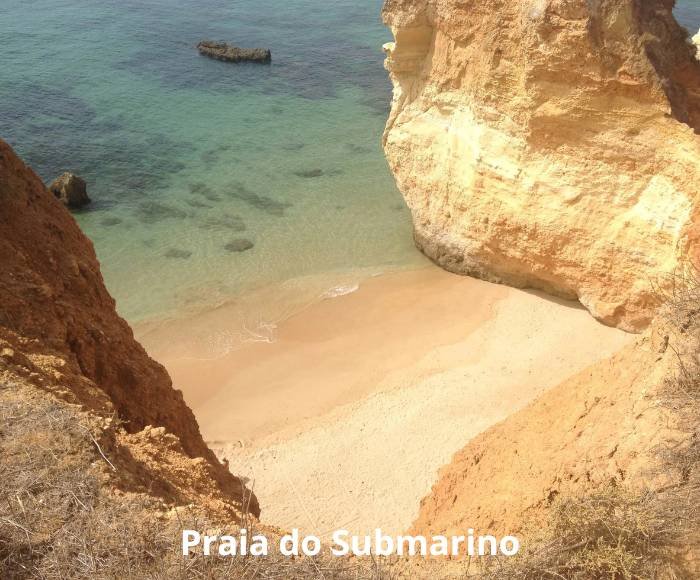
Just east of Três Irmãos lies a beach with one of the Algarve’s most evocative names. Praia do Submarino owes its name to a huge limestone rock standing alone in the water which, from a certain angle, looks remarkably like a submarine surfacing. It is a discreet cove, often overlooked by visitors who stay on the main beaches, offering a wild and unspoilt setting.
The spot is a true natural aquarium. Sheltered from the waves by the surrounding rock formations, the water is often perfectly calm and crystal clear, making it a favourite place for snorkelling. Swimming around the stone “submarine” is a fun and unmissable experience for anyone who enjoys unique photo opportunities.
-
Amo-te Olhão tip: Access is mainly possible at low tide by walking from the neighbouring Prainha beach (towards the east). Be careful not to get caught out by the rising tide, which can cut off the way back!
- View on Google Maps : click here.
Praia de João de Arens (Portimão)
♥ Favourite
📍 Location: Portimão (west) | 🤫 Secret spot | 🍑 Naturism | 🧗 Challenging access | 📸 Wild coves
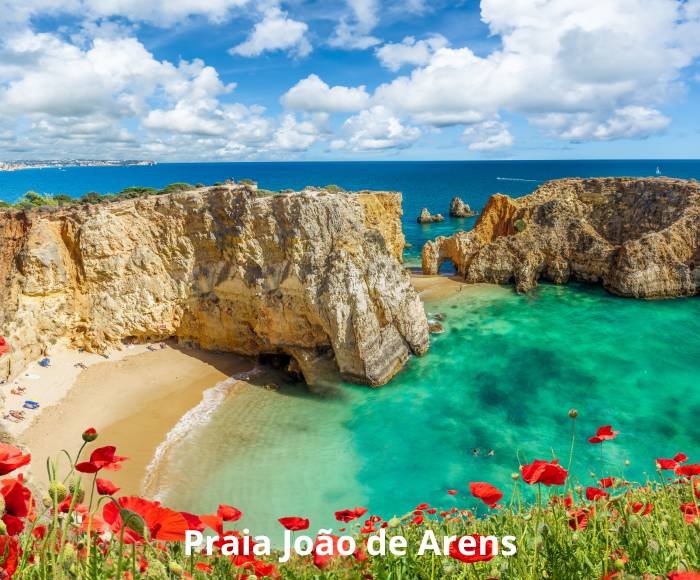
This is a delightful anomaly: a wild, almost deserted sanctuary tucked exactly between the busy beaches of Alvor and Vau. Praia de João de Arens is not just a single beach, but a wooded headland hiding a maze of tiny coves, natural arches and caves, accessible only to those curious enough to venture along the dirt paths winding through the pine forest.
The lack of signposting and the slightly steep access protect this place from mass tourism. Down below, the atmosphere is intimate, almost private. Ochre cliffs sculpted by erosion form natural alcoves, perfect for finding your own secluded spot. It has become a favourite place for naturism thanks to its discretion, and the water is remarkably clear, ideal for exploring the seabed around the rocks that have fallen into the sea.
-
Amo-te Olhão tip: Forget flip-flops! Access involves descending a steep, rocky path, so wear proper trainers. Once settled in your own private cove, you won’t want to leave.
- View on Google Maps : click here.
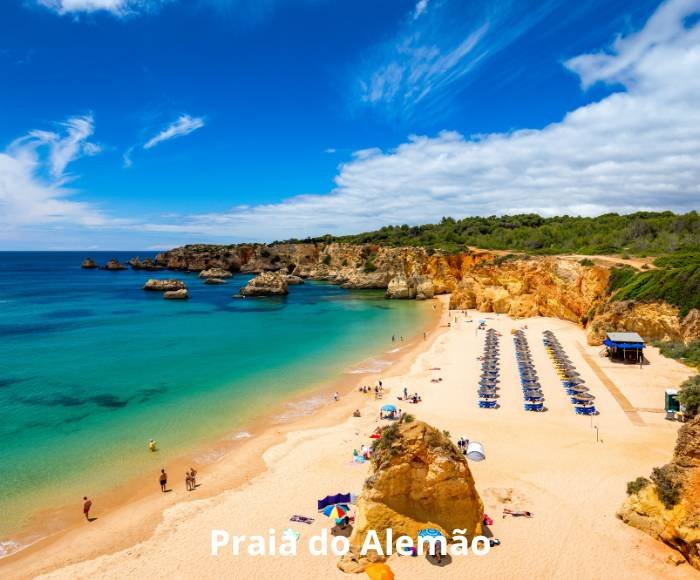
Praia do Alemão (Portimão)
📍 Location: Portimão (West) | 🌿 Nature | 🚶 Cliff Trail | 🏊 Natural Pools | 🤫 Quiet
Located at the western end of the long Vau bay, Praia do Alemão (“German Beach”) marks a perfect transition between wild cliffs and fine sand. Less urban than its neighbours, it is bordered by beautifully sculpted rock faces known as the “Varandas” (balconies), which form natural viewpoints overlooking the ocean.
This beach is a favourite with locals looking to escape the bustle of Praia da Rocha. The geology here is wonderfully irregular: at low tide, numerous rocks scattered in the water create stunning natural pools where the water warms in the sun, much to the delight of children. The atmosphere is peaceful, carried by the sound of the waves and the scent of pine trees crowning the cliffs above.
-
Amo-te Olhão tip: Don’t stay only on the sand! Take the “Varandas sobre o Mar” hiking trail starting from the top of the cliff. It connects this beach to Praia do Vau and offers breathtaking panoramic views.
- View on Google Maps : click here.
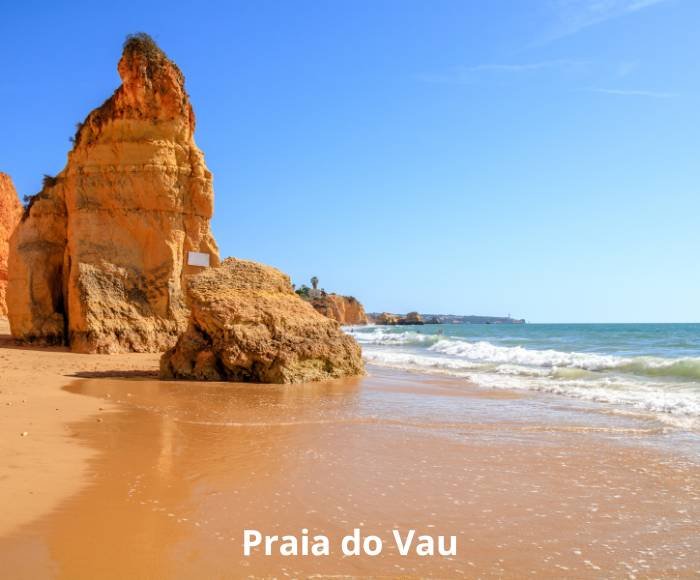
Praia do Vau (Portimão)
📍 Location: Portimão (west) | 🧖 Healing clay | 🏖️ Spacious & calm | 👨👩👧👦 Great for families
This is one of Portimão’s most iconic beaches, for a very specific reason. Praia do Vau is famous for its friable clay cliffs and its air, reputed to be particularly rich in iodine. It’s not unusual to see beachgoers covering themselves in yellow clay collected directly at the foot of the cliffs, enjoying a free natural spa before rinsing off in the ocean.
Geographically, it is a wide bay of fine sand, sheltered from the prevailing winds, which means the sea is often glassy and very safe for children. The atmosphere here is more classic and family-oriented than on the wilder coves nearby, with easy, direct access. At low tide, the beach naturally connects with its neighbours, allowing for long walks with your feet in the water all the way to Praia da Rocha.
-
Amo-te Olhão tip: Do as the locals do! Look for spots where the cliff seeps slightly to collect a little clay and make yourself a natural face mask. Let it dry in the sun for 15 minutes, then dive in — guaranteed soft skin.
- View on Google Maps : click here.
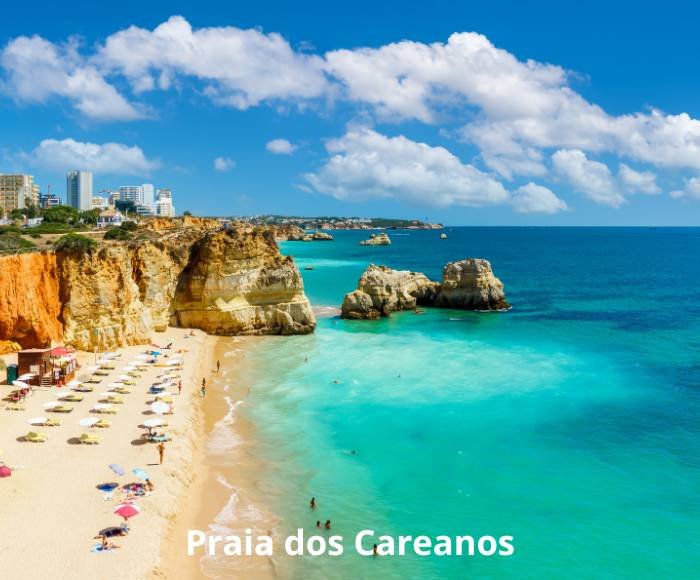
Praia dos Careanos (Portimão)
📍 Location: Portimão (between Vau and Rocha) | 🕵️ Sea caves | 🪜 Steep access | 📸 Ochre colours
This is the hidden link between Praia do Vau and the famous Praia da Rocha. Praia dos Careanos is a series of small coves nestled at the foot of steep cliffs, where colours shift from deep red to golden ochre. Less well known than its two larger neighbours, it offers a quieter, more intimate alternative, accessible only via a steep staircase that naturally discourages the crowds laden with cool boxes.
Careanos’ true appeal lies in its rugged geology. The beach is a real rock “gruyère”, dotted with caves, alcoves and natural tunnels carved by the sea at the base of the cliffs. It’s a fantastic playground for curious explorers, and the eroded rocks scattered across the sand provide welcome natural shade on hot summer days.
-
Amo-te Olhão tip: This beach changes dramatically with the tide. Come at low tide to explore all the caves without getting your feet wet.
- View on Google Maps : click here.
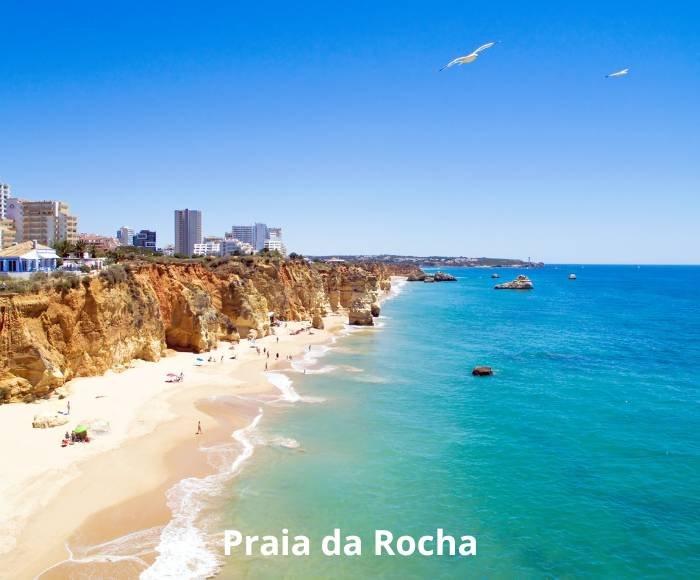
Praia da Rocha (Portimão)
📍 Location: Portimão (city centre) | 🏙️ Urban & vibrant | 🌙 Nightlife | 🏐 Sports | 🏰 Fortress
This is the “Grand Dame” of the Algarve — the beach where tourism first took off. Praia da Rocha is a vast, spectacular stretch of sand extending for over a kilometre, bordered by a pleasant wooden promenade. Unlike the wild coves, this is an urban and vibrant beach, backed by an ochre cliff topped with hotels, casinos and bars. Its energy never fades, summer or winter.
Despite its popularity and the dense urban backdrop, the beach is so wide that it never feels crowded. It’s an ideal playground for beach sports enthusiasts (volleyball, football) and for long walks along the shoreline. At its western end, the rock formations known as the “Three Bears” add a photogenic geological touch to this lively seaside setting.
-
Amo-te Olhão tip: Walk to the eastern end of the beach and head up to the Fortaleza de Santa Catarina. The panoramic view over the vast beach on one side and the mouth of the Arade River on the other is breathtaking, especially at sunset.
- View on Google Maps : click here.
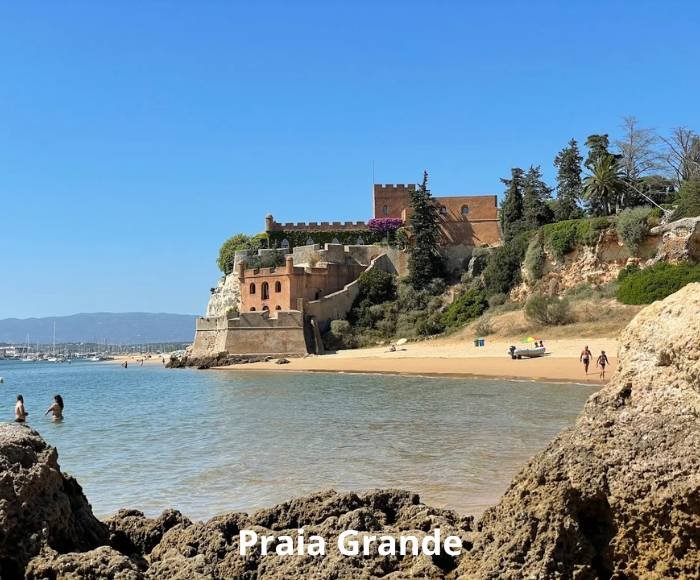
Praia Grande (Ferragudo)
📍 Location: Ferragudo (estuary) | 🏰 Castle views | 🍸 Beach clubs | 🚣 Calm waters | 🎵 Live music
Located just across the mouth of the Arade River, opposite Portimão, Praia Grande offers a completely different setting. This is a wide estuary beach, sheltered from Atlantic swells by long breakwaters, ensuring exceptionally calm and safe waters — ideal for swimming with young children or for paddleboarding. At its northern end, the beach is overlooked by the beautiful Castelo de São João do Arade, a private medieval fort that gives the place a romantic, historic feel.
The atmosphere here is more chic and relaxed than on the opposite bank. Praia Grande is well known for its excellent beach clubs (such as Club Nau), which often host live music right on the sand. It’s the perfect spot for those who enjoy combining laid-back beach time, good food and uninterrupted views of boats gliding back into the harbour.
-
Amo-te Olhão tip: Stay until sunset for a pre-dinner drink. Watching the sun sink behind the skyline of Praia da Rocha and the fortress opposite, while listening to a live jazz or bossa nova set at a beach bar, is a truly special moment.
- View on Google Maps : click here.
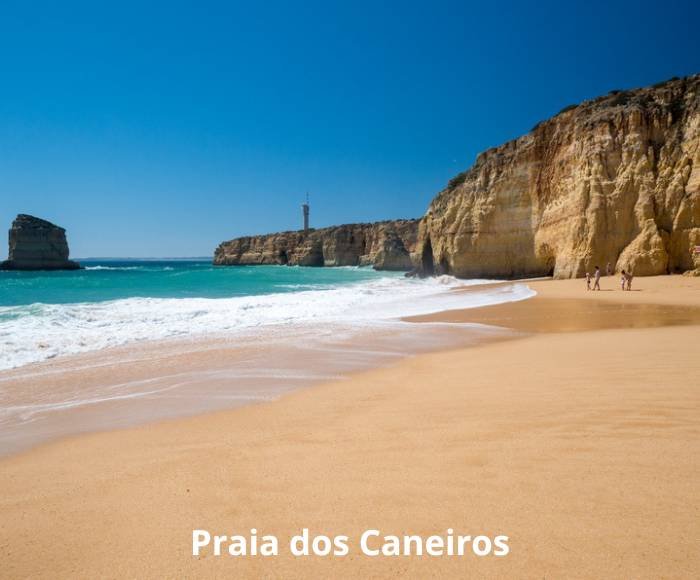
Praia dos Caneiros (Ferragudo)
📍 Location: Ferragudo (south) | 🥂 Chic & VIP | 📸 Iconic rock | 🌅 Lighthouse views | 🍽️ Dining
This is Ferragudo’s ultimate postcard beach, the one most often featured in luxury brochures. Praia dos Caneiros is a golden-sand cove backed by high ochre cliffs, facing a huge isolated rock rising from the water: Leixão das Gaivotas (Seagull Rock), which provides shelter for many seabirds.
The atmosphere here feels exclusive and refined, largely thanks to the presence of the famous stilted restaurant “Rei das Praias”, a favourite with celebrities and food lovers alike. Despite this chic reputation, the beach retains a raw natural beauty, with uninterrupted views towards the nearby Ponta do Altar lighthouse. The water is usually calm and a deep, intense blue.
-
Amo-te Olhão tip: If you plan to dine at the restaurant, book weeks in advance during summer. Otherwise, simply enjoy a drink at the beach bar at sunset — the light filtering through Seagull Rock is an unforgettable sight.
- View on Google Maps : click here.
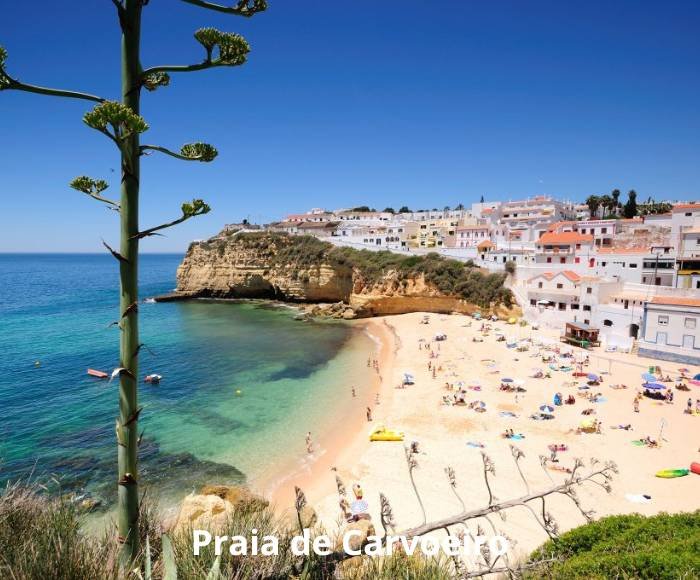
Praia do Carvoeiro (Lagoa)
📍 Location: Carvoeiro (town centre) | 🏘️ Charming village | 🛥️ Boat tours | 🍦 Ice creams & restaurants | 👨👩👧👦 Family-friendly
This is the quintessential Algarve postcard image, the one featured in every travel brochure. Praia do Carvoeiro is a small golden-sand bay set within a natural amphitheatre formed by cliffs topped with whitewashed houses stacked above one another. The former fishing village has become a very popular seaside resort, yet the charm remains thanks to the colourful boats still resting on the sand, ready to take visitors out to the nearby caves.
The atmosphere is friendly, lively and very family-oriented. The beach opens directly onto the village’s main square, lined with ice-cream parlours, restaurants and shops, making it easy to move from your towel to a terrace in seconds. It’s the ideal starting point for boat trips to the Benagil Cave, but be aware: the beach is small and extremely popular, so it fills up quickly in summer.
-
Amo-te Olhão tip: Don’t stay only on the sand! Take the wooden boardwalk (Passadiços do Carvoeiro) starting from the top of the cliff to the east. It leads to Algar Seco, a spectacular rocky landscape with natural windows opening out over the sea.
- View on Google Maps : click here.
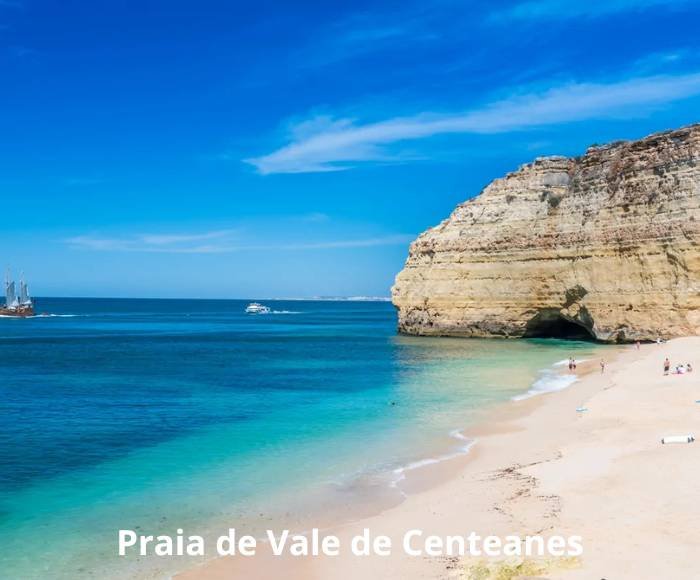
Praia de Vale de Centeanes (Lagoa)
📍 Location: Carvoeiro (east) | 🥾 Hiking trail start | 🧱 High cliffs | 🏄 Surf (winter) | 🍹 Beach bar
Tucked away at the bottom of a deep valley, Praia de Vale de Centeanes is an impressive beach framed by towering golden cliffs. It is larger than Carvoeiro, offering more room to lay out your towel, although high tide significantly reduces the available stretch of sand. The water deepens quite quickly here, and in winter it becomes a surf spot appreciated by locals.
Above all, this beach is world-famous as the official starting (or finishing) point of the Seven Hanging Valleys Trail (Sete Vales Suspensos), voted one of the best hikes in Europe. It’s a place where swimmers in swimsuits meet hikers in walking shoes, creating a relaxed, sporty atmosphere. The surrounding cliffs provide natural shelter from the wind, making it especially pleasant outside the high season.
-
Amo-te Olhão tip: Time to lace up your trainers! Even if you don’t walk the entire trail, climb at least the staircase on the eastern side of the beach to reach the top of the cliffs. The plunging view over the beach and the rugged coastline is one of the most beautiful in the region.
- View on Google Maps : click here.
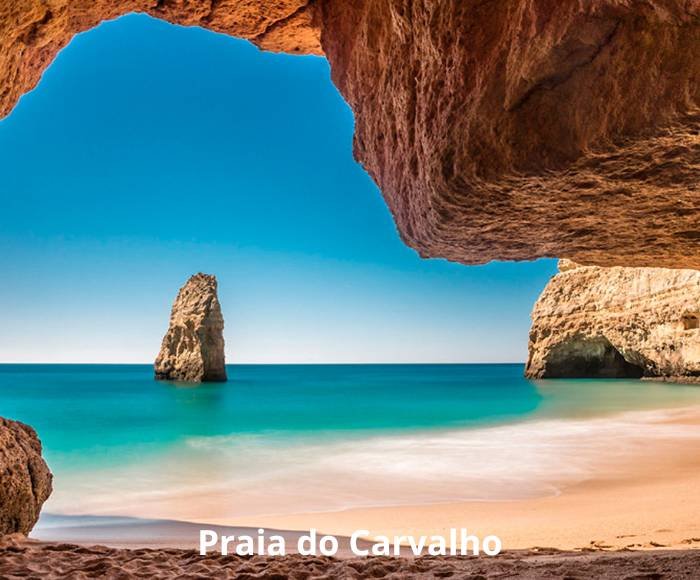
Praia do Carvalho (Lagoa)
📍 Location: Benagil (west) | 🏴☠️ Smugglers’ cove | 🚇 Tunnel access | 💦 Cliff jumping | 🤫 Sheltered
This is undoubtedly one of the Algarve’s most romantic beaches. Praia do Carvalho was once the private hideaway of a local captain (Captain Carvalho) and, according to legend, served as a landing point for pirates and smugglers. The access immediately sets the scene: you must walk through a hand-carved tunnel staircase cut directly into the ochre rock to reach the sand. A true secret passage that isolates the beach from the rest of the world.
Once through the tunnel, you discover an intimate cove, completely enclosed by high cliffs that offer excellent protection from the wind. The water is often of an almost unreal clarity, deep and turquoise. On the right-hand side, an opening in the cliff and a natural ledge act as a diving platform for the more adventurous, allowing spectacular jumps into the ocean.
-
Amo-te Olhão tip: Stop halfway through the access tunnel. There’s a “window” carved into the rock that frames a beautiful view of the ocean. It’s one of the most original photo spots in the region.
- View on Google Maps : click here.
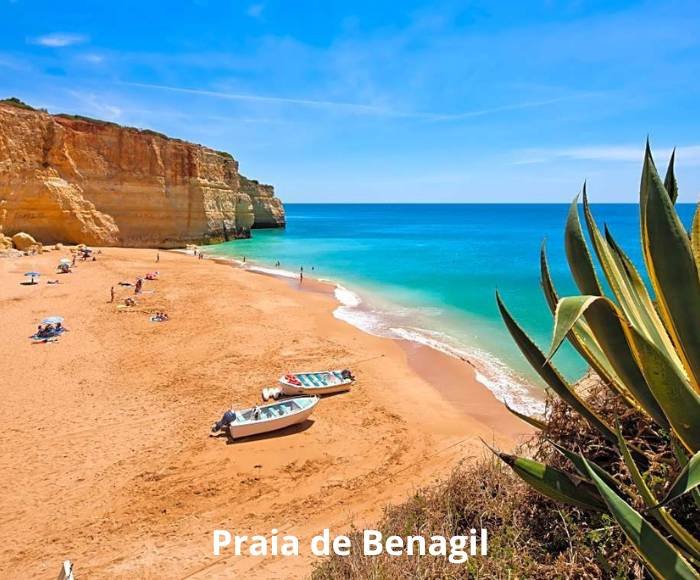
Praia de Benagil (Lagoa)
📍 Location: Benagil | 🌟 World-famous cave | 🛶 Kayak & SUP | 🚤 Nautical hub | ⚠️ Very busy
This is no longer just a beach — it’s a global phenomenon. Praia de Benagil is a small sandy cove nestled at the foot of towering cliffs, serving as the gateway to Portugal’s most famous natural wonder: the Benagil Cave (Algar de Benagil). This marine cathedral, located just around the cliff (but invisible from the beach), is a vast cave illuminated by a natural skylight in its ceiling — the iconic “eye”.
The atmosphere on the beach is that of a buzzing hive. It’s the constant departure point for boats, kayaks and stand-up paddleboards heading out to explore the cave. If you’re looking for peace and solitary relaxation, this isn’t the place. But if you want to experience the Algarve’s most iconic adventure and see this golden stone dome with your own eyes, you’re exactly where you need to be.
-
Amo-te Olhão tip: Parking is a nightmare in summer. Arrive before 8:30 am or later in the day. And for safety reasons (strong currents and heavy boat traffic), never attempt to swim to the cave, even if it looks close. Rent a kayak or a SUP to enter safely.
- View on Google Maps : click here.
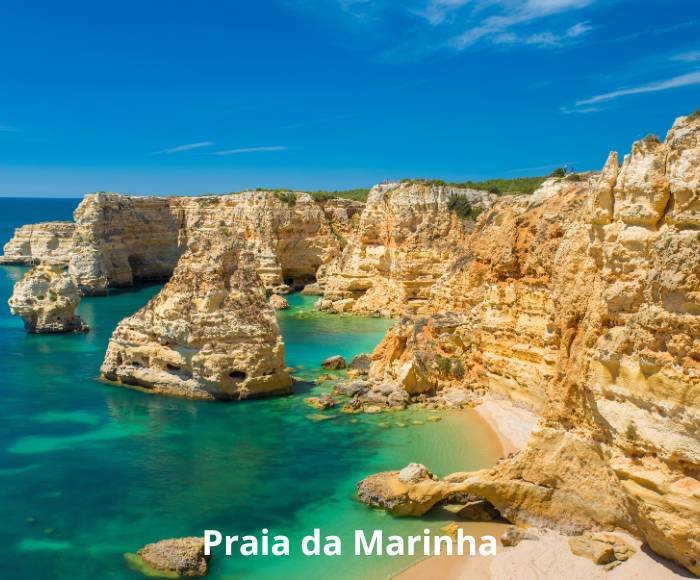
Praia da Marinha (Lagoa)
♥ Favourite
📍 Location: Lagoa (East) | 🏆 Top 100 Worldwide | 📸 “M” Rock | 🐠 Snorkelling | 🚶 End of the Hike
If you were to see just one beach, this would probably be the one. Praia da Marinha is regularly ranked among the most beautiful beaches in the world by international guides. It is the absolute masterpiece of Algarve nature: translucent turquoise water laps against golden cliffs sculpted into double arches, pillars and caves. The famous “M”-shaped rock (or an elephant, depending on your imagination) stands proudly in the water like an eternal signature.
Even before reaching the sand, the spectacle begins at the top of the cliffs, which mark the end of the famous Seven Hanging Valleys Trail. Down below, it feels like a giant aquarium. The exceptional water quality and the multitude of rocky nooks make it the best snorkelling spot on the south coast accessible directly from the shore. Despite the inevitable summer crowds, the sheer majesty of the place commands respect.
-
Amo-te Olhão tip: Before heading down the steps, walk along the cliff to the left (west). When you line up perfectly with the two natural arches, you’ll see a perfect heart formed by the rock and the ocean. It’s the ultimate romantic photo in the Algarve.
- View on Google Maps : click here.
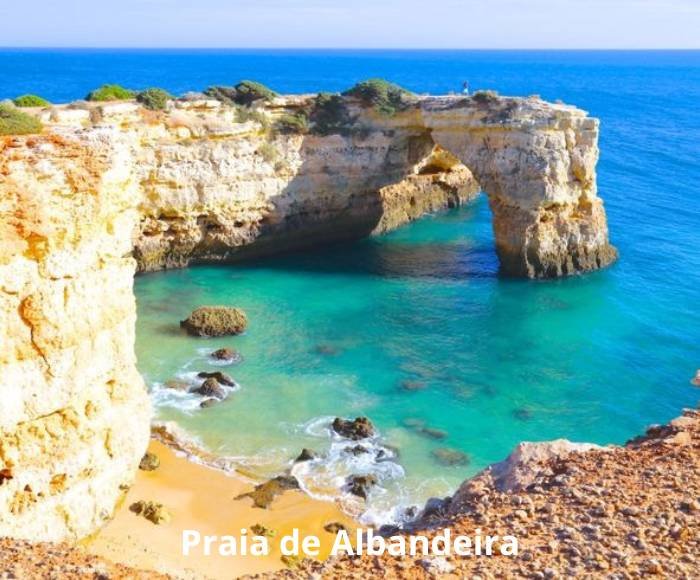
Praia de Albandeira (Lagoa)
📍 Location: Porches (Lagoa) | 🌉 Monumental arch | 🧺 Picnic spot | 📸 Photogenic | 🤫 Wild cove
This is a pocket-sized cove home to one of the Algarve’s most photogenic natural landmarks, often compared to the famous Durdle Door arch in England. Praia de Albandeira is known for its monumental stone arch (Arco de Albandeira), which stretches out into the ocean, forming a natural bridge above emerald-green waters. Unlike the larger nearby beaches, it has retained a wild and unspoilt character: no rows of sun loungers here, just sand, rock, and sea.
The beach is divided into two small coves by a rocky outcrop, creating natural shaded areas that are especially welcome on hot days. The water is often crystal clear, making it ideal for swimming beneath the arch or exploring the surroundings with a snorkel mask. This is a peaceful spot, less crowded than Praia da Marinha, perfect for those escaping concrete and seeking a truly preserved natural setting.
-
Amo-te Olhão’s tip: Take advantage of the picnic area set under the umbrella pines at the top of the cliff. It is one of the rare places along the coast where you can enjoy lunch in the shade with a “five-star” view of the arch, without having to go to a restaurant.
- See on Google Maps : click here.
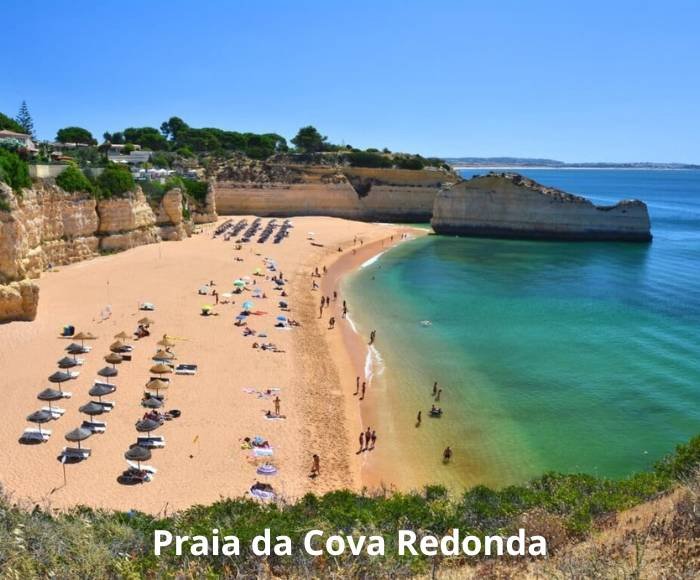
Praia da Cova Redonda (Lagoa)
📍 Location: Porches (Armação de Pêra) | 🌿 Lush vegetation | 🐚 Shell-shaped bay | 👨👩👧👦 Family-friendly | 🌊 Calm waters
This is one of the most welcoming and charming beaches in the municipality of Lagoa. Praia da Cova Redonda reveals itself after descending a long Portuguese-style paved staircase, lined with dense Mediterranean vegetation that feels like entering a secret garden. The shell-shaped beach is sheltered by a massive rocky cliff (Leixão da Gaivota), which looks like a ship run aground.
Thanks to its very enclosed layout, it is exceptionally protected from wind and waves, making it a paradise for families with young children. The water is often glassy calm. This is a beach with a gentle atmosphere — less “spectacular” than Marinha, but more intimate and lush.
-
Amo-te Olhão tip: Don’t limit yourself to the main beach. At low tide, explore the small cavities on the right-hand side. Morning light filtering through the vegetation along the steps creates beautiful colours for photography.
- View on Google Maps : click here.
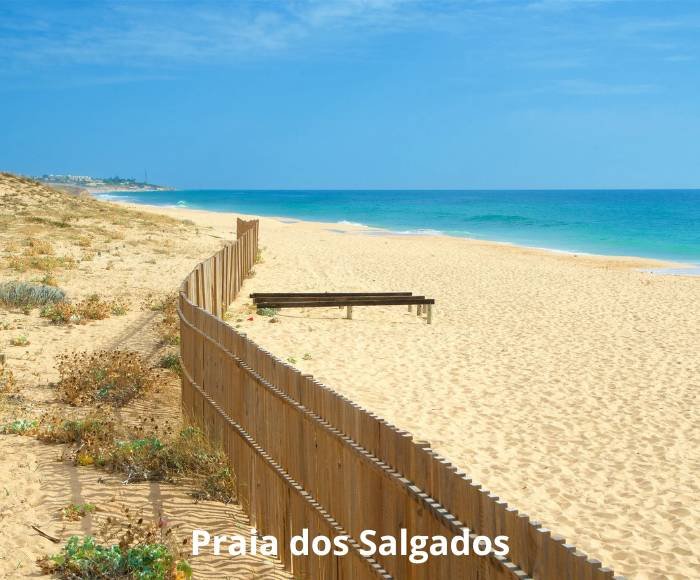
Praia dos Salgados (Albufeira)
📍 Location: Albufeira (west) | 🐦 Birdwatching | 🌾 Dunes & nature | 🚶 Long walks | 🦩 Flamingos
Here, the scenery undergoes a radical transformation. Forget golden cliffs and tucked-away coves: Praia dos Salgados marks a major geological transition. It is a vast, flat stretch of wild sand that seems to extend endlessly, separating the Atlantic Ocean from a precious freshwater lagoon, the Lagoa dos Salgados. The horizon opens up completely, offering a rare sense of space and freedom in the region.
This is an absolute paradise for lovers of raw nature and tranquillity. Access to the beach is via a network of long wooden boardwalks winding over preserved dunes, protecting a fragile ecosystem. The absence of cliffs makes the area more exposed to the wind, giving the beach a refreshing, invigorating feel — perfect for long, meditative walks far from the urban density of Albufeira.
-
Amo-te Olhão tip: Bring binoculars! The lagoon just behind the dunes is an outstanding bird sanctuary. You can often spot colonies of flamingos and purple swamphens up close in their natural habitat.
- View on Google Maps : click here.
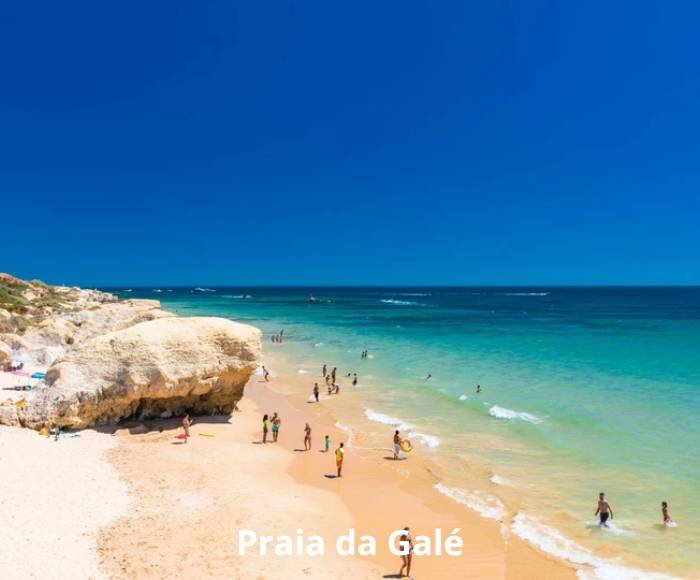
Praia da Galé (Albufeira)
📍 Location: Albufeira (West) | 🌗 Two Faces | 👨👩👧👦 Family-Friendly | 🏖️ Fine Sand | ♿ Accessible
This is a beach with two faces, offering the best of both geological worlds in the Algarve. Praia da Galé marks the exact point where the landscape changes: its western side is a vast, open and flat stretch of sand (a natural continuation of Salgados), while the eastern side suddenly rises into golden rock formations, creating intimate corners and natural rock pools. It’s this unique contrast that gives the beach its universal appeal.
Very popular with Portuguese families, it’s a friendly beach that is exceptionally well equipped. The rocky outcrops on the eastern side break the waves and create calm, shallow bathing areas, perfect for children. Accessibility is excellent (few or no stairs compared to other Albufeira beaches), and the area is home to some of the most renowned beach restaurants in the region.
-
Amo-te Olhão’s tip: Choose your side depending on your mood! If you want space and long walks, head left (West). If you’re looking for photogenic little coves sheltered from the wind, go right (East) towards the rocks.
- See on Google Maps: click here.
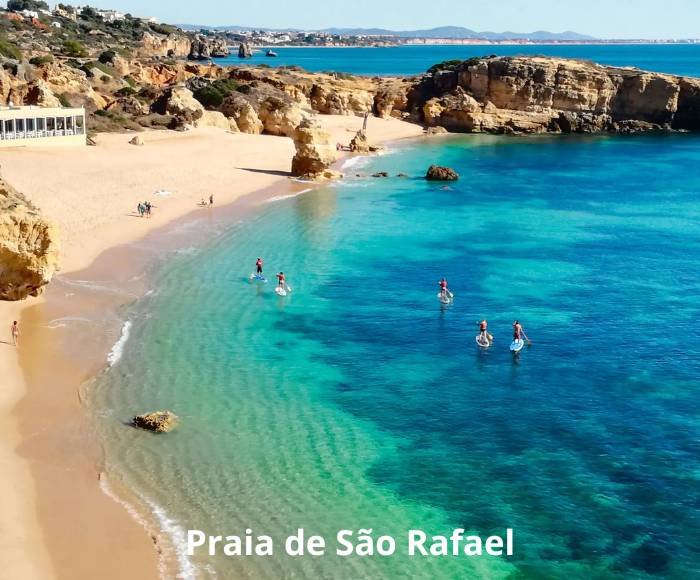
Praia de São Rafael (Albufeira)
♥ Favourite
📍 Location: Albufeira (West) | 🎨 Sculpted rocks | 🛶 Kayaking | 🍹 Beach club | 📸 Postcard views
This is undoubtedly the most beautiful beach in the Albufeira area, an open-air geological masterpiece. Praia de São Rafael stands out for its limestone formations with evocative shapes (such as the famous “Ponte Pequena” or the “Swallow’s Nest”) rising from turquoise waters. Unlike long, monotonous stretches of sand, the landscape here is lively, fragmented and incredibly photogenic.
The atmosphere is sophisticated yet relaxed. Although very close to the buzz of Albufeira, the beach retains a wild charm thanks to the absence of large buildings in the background, replaced instead by lush natural surroundings. The water is crystal clear, inviting exploration by kayak or paddleboard as you weave between the golden stone pillars scattered across the bay.
-
Amo-te Olhão’s tip: Don’t stay glued to your towel! Take the cliff-top path on the right-hand (west) side. The plunging view over the submerged rocks and the many shades of blue in the water is absolutely spectacular, worthy of the most beautiful lagoons.
- See on Google Maps : click here.
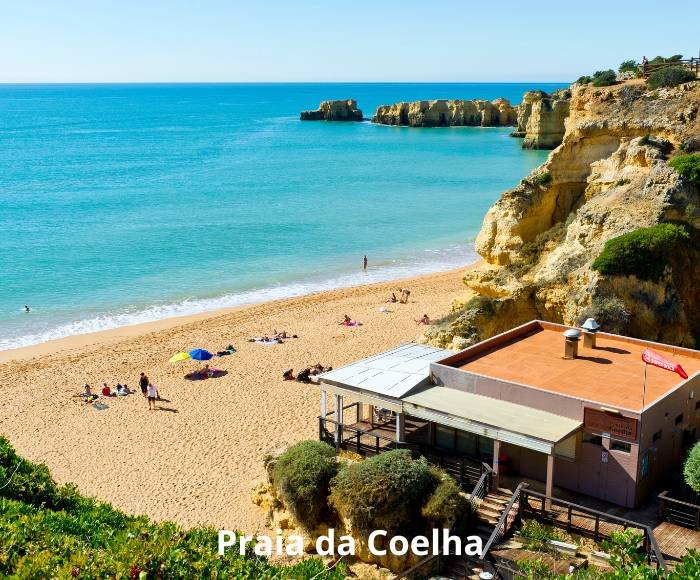
Praia da Coelha (Albufeira)
📍 Location: Albufeira (Sesmarias) | 🐇 Hidden Cove | 🌿 Nature Trail | 🐚 Shells | 👨👩👧👦 Family-Friendly
Its name means “Rabbit Beach”, and it truly lives up to its hidden-burrow feel. Praia da Coelha is earned rather than reached easily: to get there, you follow a short and charming dirt path winding through ancient olive trees and carob trees. This gentle walk naturally filters the crowds and preserves the peaceful atmosphere, far from urban noise.
At the end of the path, a perfectly shell-shaped cove reveals itself, sheltered from the wind by high golden cliffs. The water is exceptionally calm and crystal clear. It’s a cosy, intimate beach where scattered rocks create pockets of natural shade. The vibe is very family-friendly, accompanied by the sound of cicadas in the surrounding vegetation.
-
Amo-te Olhão’s tip: Don’t forget your mask! The seabed around the rocks on the right side of the beach is full of marine life. It’s also a great spot for collecting beautiful shells often brought in by the tide.
- View on Google Maps : click here.
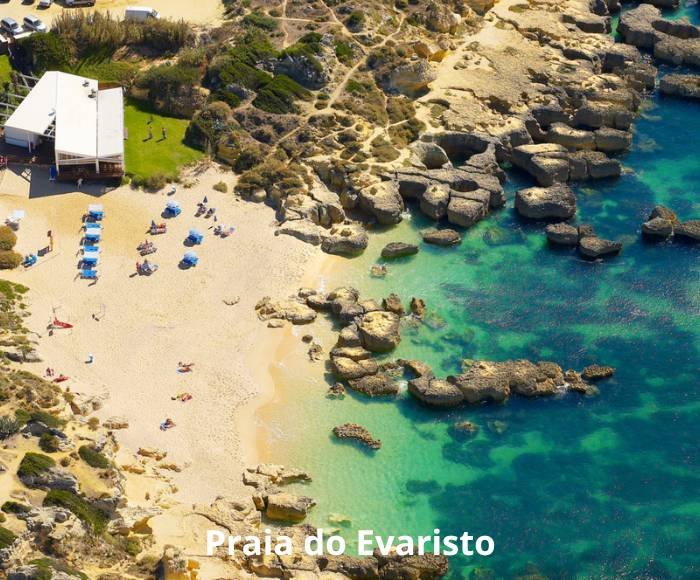
Praia do Evaristo (Albufeira)
📍 Location: Albufeira (Sesmarias) | 🍽️ Famous Restaurant | 🤿 Top Snorkelling | 🧱 Rocky | 🦀 Nature
Located between Castelo and Galé beaches, Praia do Evaristo is a small rocky cove full of character. Unlike the long sandy stretches nearby, nature here is raw and untamed: the beach is dotted with large sea-smoothed boulders, creating a wild, almost lunar landscape. It takes its name from the famous beachfront restaurant “Evaristo”, a local institution popular with Portuguese celebrities and seafood lovers alike.
This is a dream spot for explorers. The lack of flat sand in some areas and the abundance of rocky corners make it one of the best places in the region to observe marine life — crabs, fish and even octopus — with just a mask and snorkel, right by the shore.
-
Amo-te Olhão’s tip: If you enjoy snorkelling, this is the place to be. Swim around the submerged rocks: the water is crystal clear and marine life is far richer here than on purely sandy beaches.
- View on Google Maps : click here.
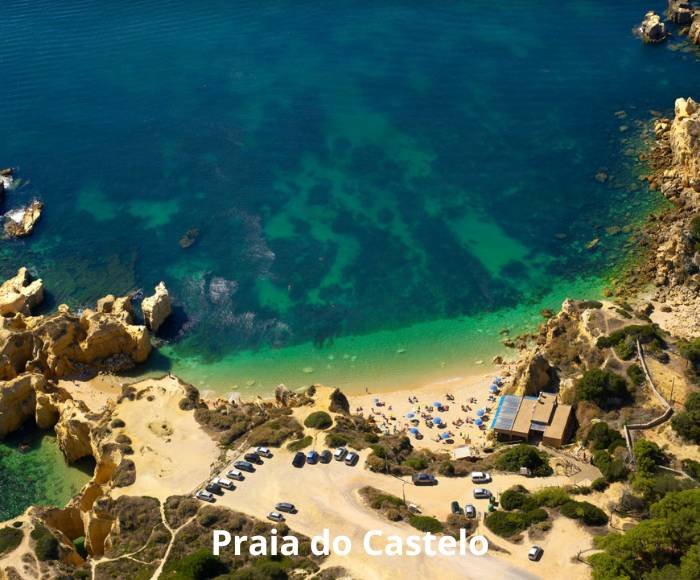
Praia do Castelo (Albufeira)
📍 Location: Albufeira (Sesmarias) | 🏰 Natural “Castle” | 🛡️ Sheltered | 🐠 Snorkelling | 📸 Cove
Its name means “Castle Beach”, and a single glance at the cliffs is enough to understand why. Praia do Castelo is a small cove nestled between vertical rock walls that cut into the sky like medieval battlements and watchtowers. It is a spectacular natural setting where geology mimics architecture, creating the atmosphere of a secret fortress protecting the beach from the outside world.
The place is a true gem for lovers of intimate coves. Thanks to its high natural walls, the beach is very well sheltered from the wind, offering a warm and comfortable refuge even when the breeze is strong elsewhere. The entry into the water is fairly steep, but the clarity of the ocean here is exceptional, inviting swimmers to explore around the large rock blocks that have fallen into the sea and now serve as a refuge for fish.
-
Amo-te Olhão’s tip: Don’t limit yourself to the main beach! At low tide, slip between the rocks on the right-hand side. You’ll discover tiny hidden coves (“pockets” of sand) where you can feel completely alone in the world — like the king of your own castle.
- View on Google Maps : click here.
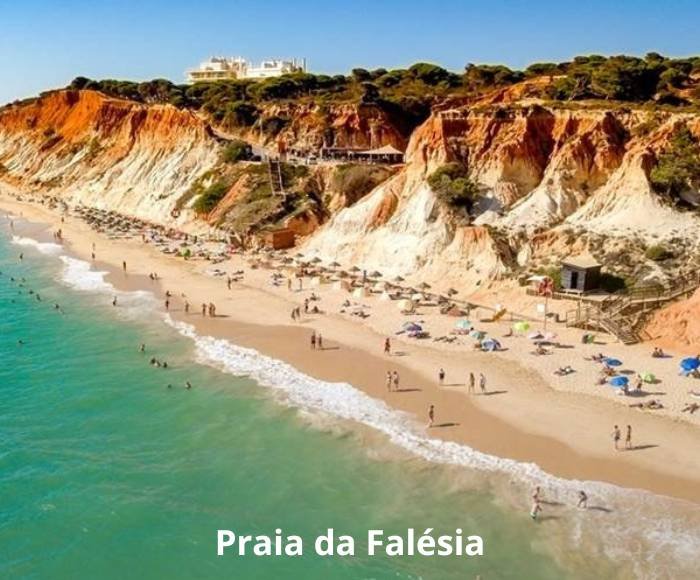
Praia da Falésia (Albufeira)
♥ Favourite
📍 Location: Albufeira > Vilamoura | 🏆 World No.1 (TripAdvisor) | 🧱 Red Cliffs | 🏃 6 km of Sand | 🌅 Sunset
This is the spectacular grand finale of the rocky coastline — an endless wall that seems to separate land from sea. Praia da Falésia is a unique geological phenomenon: a vast beach stretching over more than 6 kilometres, bordered by a continuous cliff displaying striking tricolour layers (white, ochre and deep red), topped with a forest of green pine trees. It is a living canvas that changes colour throughout the day.
Regularly voted “World’s Best Beach”, it impresses by its sheer scale. Here, unlike the small coves, space feels limitless. It is a paradise for walkers and joggers, who can stroll barefoot in the sand from the village of Olhos de Água all the way to Vilamoura Marina. The immensity of the landscape makes you feel wonderfully small in front of nature’s power.
-
Amo-te Olhão’s tip: The magical moment is during golden hour (about one hour before sunset). The red cliffs literally ignite under the low sunlight, creating a dramatic contrast with the blue of the ocean. It is the most beautiful free show in the Algarve.
- View on Google Maps : click here.
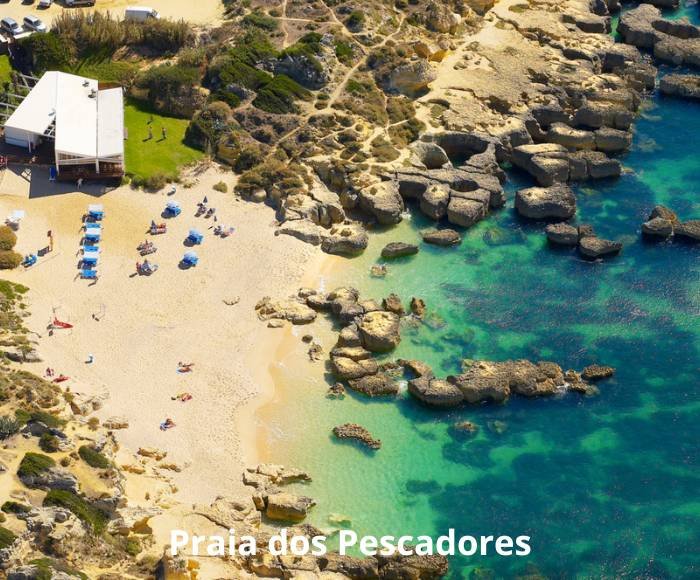
Praia dos Pescadores (Albufeira)
📍 Location: Albufeira (Old Town) | 🏘️ Urban & Historic | ⚓ Colourful Fishing Boats | 🛍️ Lively Atmosphere | 🪜 Escalators
This is the beating heart and historic soul of Albufeira. Praia dos Pescadores (Fishermen’s Beach) lies directly at the foot of the whitewashed houses of the Old Town. Although tourism has largely replaced fishing, a few traditional colourful boats can still be seen resting on the sand, reminding visitors of the town’s original identity. It is a lively urban beach, easily accessible thanks to the famous escalators descending the cliff or via the tunnel from the town centre.
The atmosphere here is vibrant and full of life: music drifting from bars, families enjoying the beach, and the constant buzz of the nearby main square. It’s the perfect spot for those who want everything within walking distance — swimming, shopping, ice creams and restaurants — without needing a car.
-
Amo-te Olhão’s tip: Go up to the viewpoint (Miradouro) at the top of the western escalator. The panoramic view over the amphitheatre of white houses cascading down to the blue sea is the city’s most iconic image.
- View on Google Maps: click here.
The Golden Triangle and the Ria Formosa: fine sandy beaches and lagoons
Here, we leave behind the dramatic theatre of rocky cliffs and enter a world of calm and open horizons. Gone are the secret coves reached by vertiginous staircases; the coastline flattens out and stretches endlessly, giving way to the reign of infinite sand. This is where the Atlantic Ocean meets long golden dunes and umbrella pine forests that scent the sea air.
This is the domain of the prestigious Golden Triangle of the Algarve. Between Vilamoura, Vale do Lobo and Quinta do Lago, the coastline takes on a refined elegance. Vast, immaculate beaches border luxury estates and world-class golf courses. It is a coast where lifestyle reigns supreme, offering landscaped seafront walks, sunsets over the dunes and a distinctly chic yet relaxed atmosphere.
But this area also marks a major ecological transition. As you approach Faro, the landscape subtly transforms into the sanctuary of the Ria Formosa. The first lagoons appear, wildlife reclaims its space, and the beaches detach from the mainland to become barrier islands — true sand ramparts set against the ocean.
From the cosmopolitan buzz of Vilamoura marina to the wild wooden walkways of Ilha de Faro, we take you to discover these wide-open spaces where you can walk for hours without ever meeting an obstacle, between the deep blue of the sea and the intense green of the pine forests.
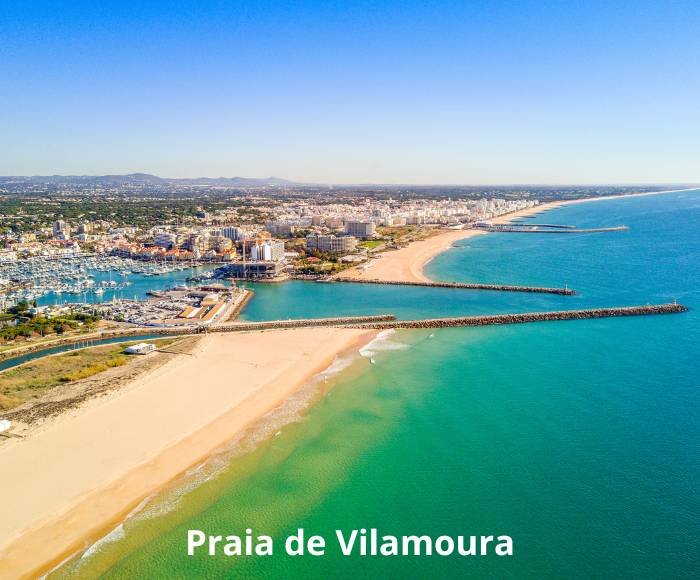
Vilamoura Beach (Loulé)
📍 Location: Vilamoura (Marina) | 🛥️ Marina | 🍸 Beach Clubs | 🌇 Sunset Parties | ♿ Accessible
This is the most sophisticated and “glamorous” beach in central Algarve. Located between the famous Vilamoura Marina and the port of Quarteira, Vilamoura Beach is a wide stretch of fine, pale sand that perfectly embodies relaxed luxury. The atmosphere is decidedly stylish: people come here to see and be seen, and to enjoy musical sunset sessions at upscale beach clubs such as the iconic Purobeach.
Accessibility is flawless. Just steps away from yachts and five-star hotels, the beach offers calm, safe waters with full lifeguard supervision. It is a complete contrast to the wild coves of the west: here, everything is designed for absolute comfort, from plush sunbeds to wooden walkways, making it a top choice for a discerning clientele seeking service rather than adventure.
-
Amo-te Olhão’s tip: Take a walk along the jetty (the long pier) at the western end of the beach in the late afternoon. It’s the best spot to watch the elegant ballet of sailing boats and luxury yachts returning to the Marina at sunset.
- View on Google Maps : click here.
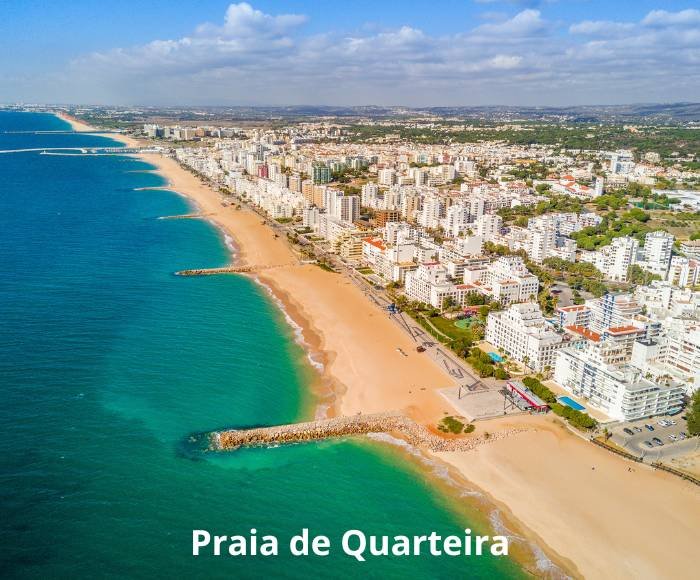
Quarteira Beach (Loulé)
📍 Location: Quarteira (Town Centre) | 🏙️ Urban | 🚶 Seafront Promenade | 🇵🇹 Local Favourite | 🌊 Calm Waters
Right next to the luxury of Vilamoura, the atmosphere shifts to something distinctly and authentically Portuguese. Praia de Quarteira is one of the most popular beaches in the Algarve among local families. It is famous for its beautiful “Calçadão”, a long palm-lined paved promenade that separates the sand from the town, offering a perfect playground for prams, bikes and joggers.
The beach is divided by a series of stone breakwaters extending into the sea, creating several sheltered bays where the water is extremely calm and shallow — a safe paradise for children. It is a lively, practical and unpretentious beach, with everything close at hand: cafés, ice-cream parlours and excellent grilled fish restaurants just behind the shoreline.
-
Amo-te Olhão tip: Take advantage of the proximity of Quarteira’s famous Fish Market (located at the western end). It is one of the most renowned in the region. Go early in the morning to see the day’s catch freshly landed, then head straight to the beach just opposite.
- View on Google Maps: click here.
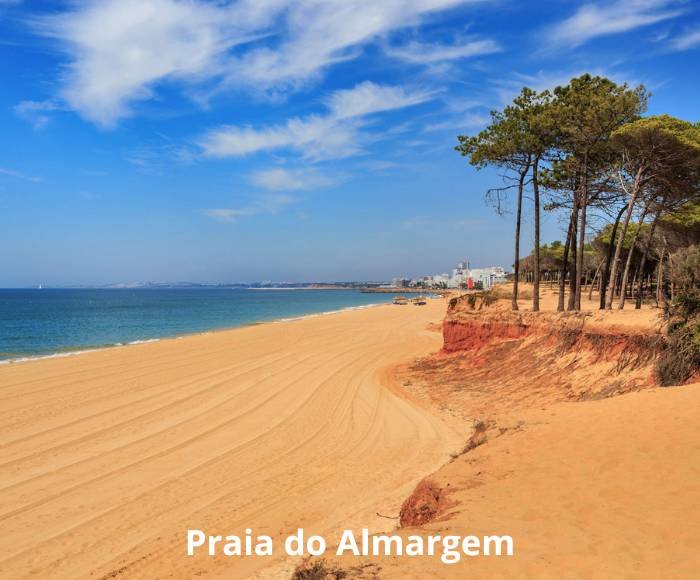
Praia do Almargem (Loulé)
📍 Location: Quarteira (East) | 🌲 Pine Forest & Dunes | 🐎 Cavalo Preto | 🦆 Lagoon | 🤫 Nature
Also known as “Cavalo Preto” (Black Horse), Praia do Almargem marks a clear break from the urban landscape of Quarteira. Here, concrete gives way to nature: a vast, fragrant pine forest stretches almost all the way down to the sand, offering rare natural shade so close to the ocean. This is the beginning of a long, wild coastal strip extending eastwards.
The beach is shaped by a small lagoon formed by the mouth of the Ribeira do Almargem, which flows into the sea (or not, depending on the season). This wetland attracts many bird species and creates a shallow freshwater pool that is especially popular with children. It is a peaceful beach, less crowded than its neighbours, perfect for those seeking space and tranquillity beneath the pine trees.
-
Amo-te Olhão’s tip: This is the ideal spot for a family picnic. Take advantage of the shade provided by the pine trees just behind the dunes to enjoy lunch during the hottest hours, before heading back for a swim.
- View on Google Maps: click here.
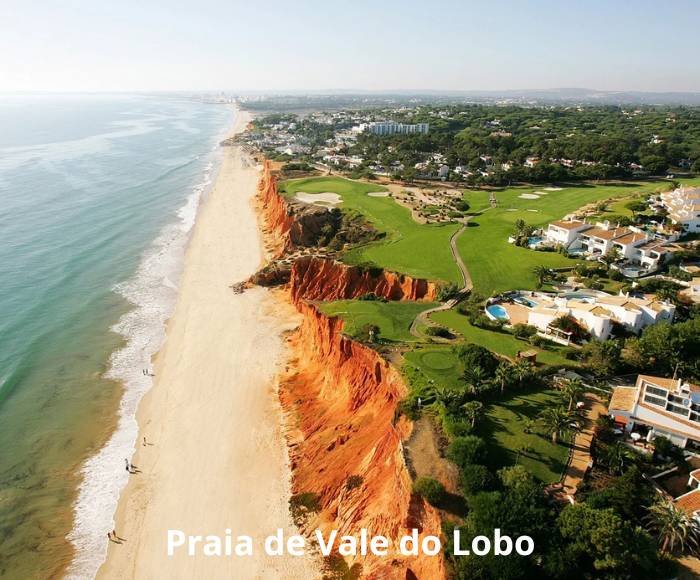
Praia de Vale do Lobo (Loulé)
📍 Location: Vale do Lobo | 💎 Luxury & Golf | 🧱 Red Cliffs | 🍸 La Praça | 📸 Iconic
We now enter the beating heart of Algarve luxury. Praia de Vale do Lobo is an iconic beach, instantly recognisable by its intense red-ochre cliffs that frame the shoreline, creating a striking contrast with the white sand. It borders one of Europe’s most exclusive golf and resort complexes, offering a sophisticated and international atmosphere.
The focal point is the famous “Praça”, a lively square located directly on the seafront, surrounded by restaurants and lounge bars. This is a beach where people come as much for the lifestyle as for swimming. Despite its glamorous appeal, the beach remains vast, and the water quality is excellent, supervised and equipped with all high-end facilities.
-
Amo-te Olhão’s tip: This is an unmissable spot at the end of the day. The musical atmosphere (often live) at the Praça at sunset, cocktail in hand facing the sea, is one of the most sought-after summer experiences in the Algarve.
- See on Google Maps : click here.
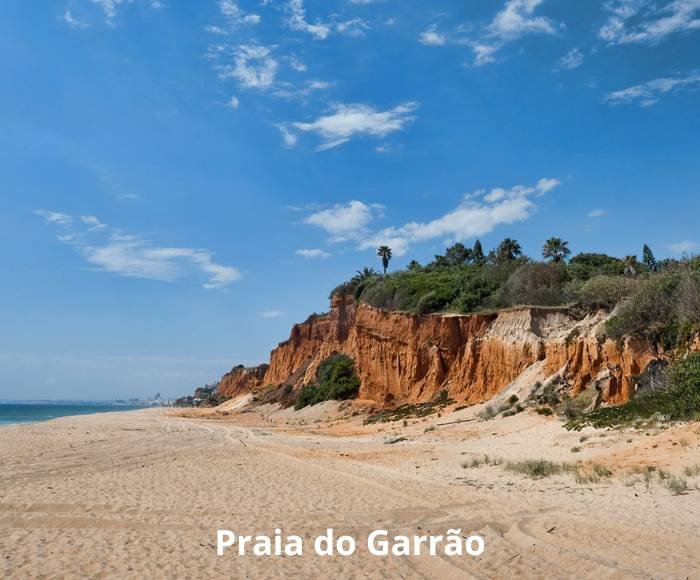
Praia do Garrão (Loulé)
📍 Location: Almancil (East Vale do Lobo) | 🍽️ Gastronomy | 🥂 Julia’s Beach | 🌲 Pine Forest | 🕺 Lively Atmosphere
Located between the exclusive resorts of Vale do Lobo and Quinta do Lago, Praia do Garrão is the go-to meeting point for the relaxed Algarve jet set. This beautiful beach is framed by rolling dunes and a pine forest, accessed via a road that winds through the trees. It perfectly combines unspoilt natural scenery with high-end beach services.
It is especially famous for its legendary beach restaurants (such as the iconic “Julia’s” or “Izzy’s”), literally set right on the sand. The atmosphere is truly unique: grilled fish lunches with your feet in the sand, followed by summer afternoons that often turn into spontaneous beach parties with live music. It’s the perfect blend of preserved nature and lively, social vibes.
-
Amo-te Olhão’s tip: This is the ideal spot if you enjoy “lively” beaches. Book your sunbed or lunch table in advance, because despite the vast stretch of sand, the serviced areas are quickly taken over by regulars who spend the entire day here.
- View on Google Maps: click here.
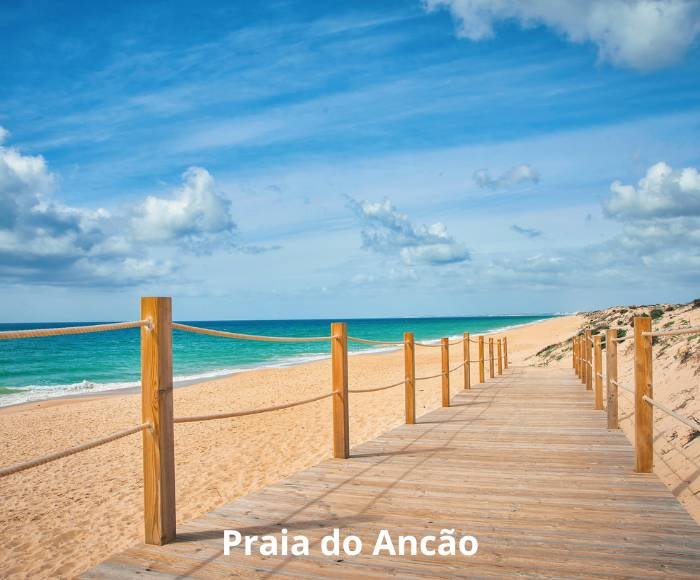
Praia do Ancão (Loulé)
📍 Location: Almancil (West Quinta do Lago) | 🌿 Natural Park | 🍽️ “2 Passos” Restaurant | 🏖️ Dunes | 🤫 Chic & Nature
Here, we officially enter the boundaries of the Ria Formosa Natural Park. Praia do Ancão is a magnificent wild beach, secluded from the world by a dense pine forest and protected high dunes. It is the natural extension of Garrão, but in a much quieter and more exclusive version, favoured by those seeking discretion within the Golden Triangle.
Access is via a road that winds through the pine forest, enhancing the feeling of escape. The beach is vast, offering an incredible sense of open space. It is also home to the iconic “2 Passos” restaurant, a local institution set on top of the dune with panoramic views over the ocean. This is where raw nature meets high-end comfort.
-
Amo-te Olhão’s tip: This is a perfect beach for long walks. Heading east (to the left when facing the sea), you can reach Quinta do Lago beach by walking alongside untouched dunes — a refreshing stroll far from any construction.
- View on Google Maps : click here.
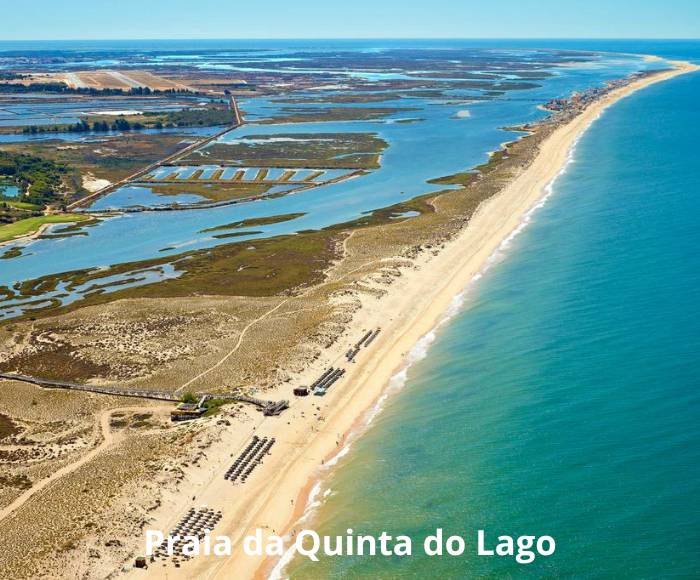
Praia da Quinta do Lago (Loulé)
📍 Location: Quinta do Lago | 🌉 Iconic Bridge | 🌿 Ria Formosa | 💎 Luxury | 🐦 Nature | 🏖️ Vast
It is one of the most recognisable images in the region. To reach the sand of Praia da Quinta do Lago, you must cross one of the longest wooden bridges in Europe (the Ponte de Madeira), which stretches majestically over the marshes of the Ria Formosa. This walk is an experience in itself, offering breathtaking views over the lagoon, tidal flats and wildlife even before setting foot on the beach.
At the end of the bridge, beyond the pristine dunes, an endless stretch of white sand unfolds. Facing one of the most exclusive resorts in Europe, the beach attracts an elegant crowd, yet its vast size allows everyone to find their own sense of tranquillity. It is a place where refined beach services meet the raw beauty of a protected natural park.
-
Amo-te Olhão’s tip: Take your time on the bridge! Don’t rush towards the sea. Look down at low tide: you’ll spot thousands of small fiddler crabs (with their oversized claw) scurrying through the mud, along with many wading birds feeding in the shallows.
- View on Google Maps : click here.
Praia de Faro (Ilha de Faro)
📍 Location: Faro | 🚗 Bridge Access | ✈️ Plane Spotting | 🌊 Ocean & Lagoon | 🏄 Surf & SUP
This is the locals’ beach — the everyday “garden” of Faro’s residents. Praia de Faro is located on a barrier island (the Ancão Peninsula), but it is the only beach in the entire Ria Formosa that is connected to the mainland by a road bridge. It is a long 5 km stretch of sand offering a rare duality: on one side, the often lively Atlantic Ocean, popular with surfers; on the other, the calm, warmer waters of the lagoon, with open views over the city and the distant mountains.
The atmosphere is relaxed and lively, dotted with holiday homes, surf bars and traditional restaurants. It is a very practical beach for a final swim before catching a flight, as the airport is literally next door. Watching planes take off above the lagoon adds an unusual urban touch to this natural setting.
-
Amo-te Olhão’s tip: If you are looking for solitude, park your car and walk (or cycle) eastwards, towards the end of the paved road. Continue along the wooden boardwalks to the “Barrinha”. There, far from cars, nature takes over again and the water becomes incredibly clear.
- View on Google Maps : click here.
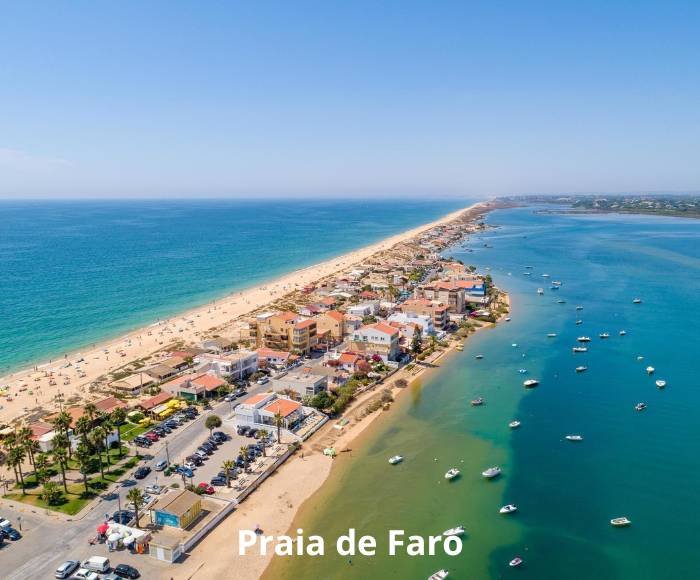
The Sotavento and Ocean Beaches: Warmer Waters and Endless Sand
Welcome to the Sotavento, the “leeward” coast. Here, the landscape changes dramatically one last time. The ochre cliffs and secret coves of the west are now a distant memory. They give way to vast stretches of flat, white sand that run endlessly toward the horizon, bordered by low dunes covered with coastal vegetation and umbrella pines.
The great distinguishing feature of this region is the water temperature. Thanks to the nearby influence of the Mediterranean and the shallow sandbanks, the ocean here is noticeably warmer (sometimes reaching 24–25°C in summer), making for long, relaxed swims. It is a paradise for families and for those who find the Atlantic on the west coast a little too bracing.
Here, we move away from the bustle of the central tourist areas to rediscover a more authentic Algarve, punctuated by historic fishing villages such as Santa Luzia and Cacela Velha. This is a luminous coast where the blue of the sky blends seamlessly with that of the sea, creating a powerful sense of space and freedom.
From the iconic anchor cemetery of Barril to the crystal-clear waters of Praia Verde, we take you along these beaches where access requires no boat—just a walk across a dune or a bridge—to enjoy the gentle pace of life in the eastern Algarve.
Praia do Barril (Tavira)
♥ Favourite
📍 Location: Santa Luzia (Tavira) | 🚂 Little Train | ⚓ Anchor Cemetery | 📸 Unusual | 👨👩👧👦 Family
This is far more than just a beach — it’s a journey through time and Algarve history. Located on Tavira Island, Praia do Barril is famous for its picturesque access: you reach it by crossing the lagoon via a floating bridge, then taking a charming little tourist train (or walking) for about one kilometre through the dunes. An adventure that delights children even before they see the sea.
But the true symbol of the place is its impressive Anchor Cemetery. Lined up in the dunes facing the ocean, hundreds of rusted anchors pay a silent and highly photogenic tribute to the golden age of tuna fishing. The former fishermen’s buildings have been converted into restaurants and cafés, creating a unique cultural setting on a pristine stretch of white sand.
-
Amo-te Olhão’s tip: If you’re looking for peace and quiet, don’t stop at the anchors. Walk west (to the right facing the sea) for 10–15 minutes and you’ll quickly reach Praia do Homem Nu, a wild and officially naturist beach where you can truly feel alone in the world.
- View on Google Maps: click here.
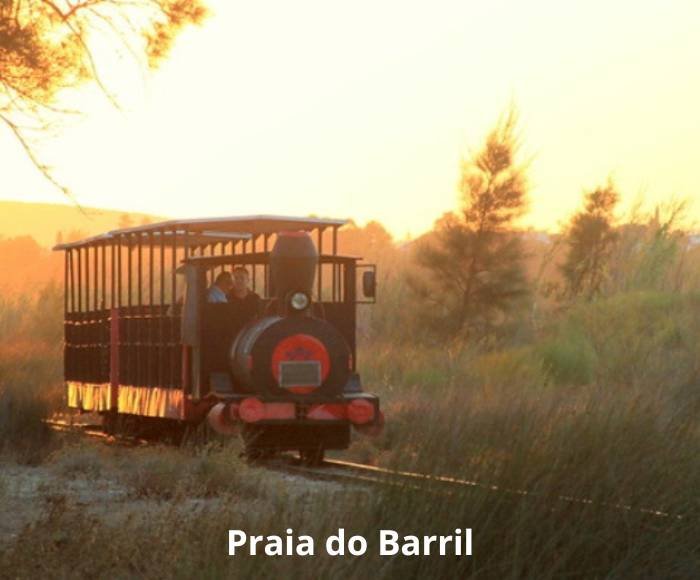
Praia da Manta Rota (Vila Real de Santo António)
📍 Location: Manta Rota | 🌡️ Warm Water | ♿ Easy Access | 👨👩👧👦 Family-Friendly | 🏖️ Endless Sand
This is a major geographical shift: here, there’s no need for a boat or a floating bridge. Praia da Manta Rota marks the point where the dune system of the Ria Formosa reconnects with the mainland. This makes it one of the most accessible and expansive beaches in the eastern Algarve — a vast ribbon of fine sand bordered by low dunes and a lively seaside village.
Its strong reputation comes from the temperature of the water. Thanks to its location and gently sloping sandbanks, the sea here is often warmer than anywhere else in the Algarve, sometimes feeling almost Mediterranean. It is the ultimate family beach, with shallow water stretching far out, perfect for paddle games and long, relaxing swims without the powerful Atlantic waves of the west.
-
Amo-te Olhão’s tip: This is the starting point for a beautiful walk. At low tide, head east (to the left when facing the sea) and walk along the shoreline for about 20–30 minutes. You’ll reach the peninsula of Cacela Velha directly by the beach — a spectacular arrival at the foot of this historic village.
- View on Google Maps: click here.
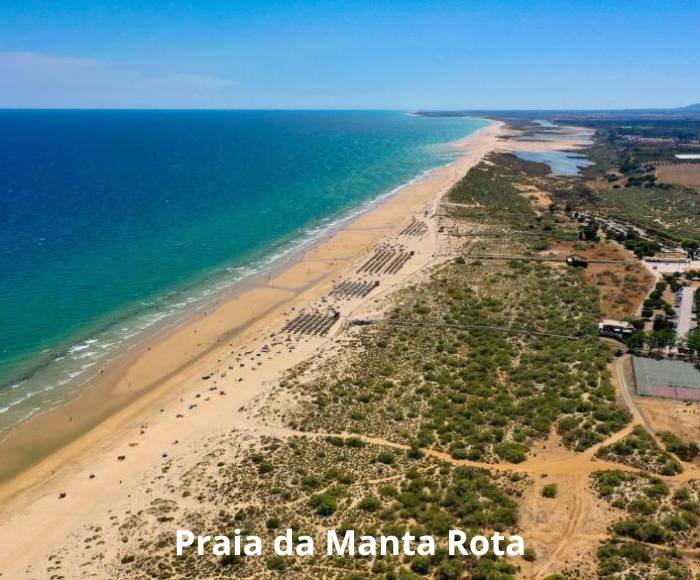
Praia de Cacela Velha (Vila Real de Santo António)
♥ Favourite
📍 Location: Cacela Velha | 🖼️ Most Beautiful View | 🏰 Historic Village | 🚶 Wading Crossing | 📸 Magical
Even before your feet touch the sand, it’s the view that takes your breath away. Praia de Cacela Velha lies below a tiny fortified white village perched on a fossil cliff. From the church square, the panorama over the Ria Formosa — constantly changing colour with the tides, shifting from turquoise to deep blue and the golden tones of sandbanks — is regularly ranked among the most beautiful landscapes in the world.
The beach itself is a long, untouched sand peninsula, separated from the mainland by a narrow lagoon channel. It’s a wild place, completely free of buildings, where you feel fully connected to the elements. No sunbeds, no music — just the sound of the wind and birds. This is the very essence of the original Algarve, a living canvas of pure and soothing beauty.
-
Amo-te Olhão’s tip: Getting there is part of the adventure. At low tide, you can wade across the lagoon on foot (water up to your knees or waist) from below the village — a fun and unforgettable experience. At high tide, small boats operate crossings, or you can reach the beach on dry land by walking along the shore from Manta Rota.
- See on Google Maps : click here.
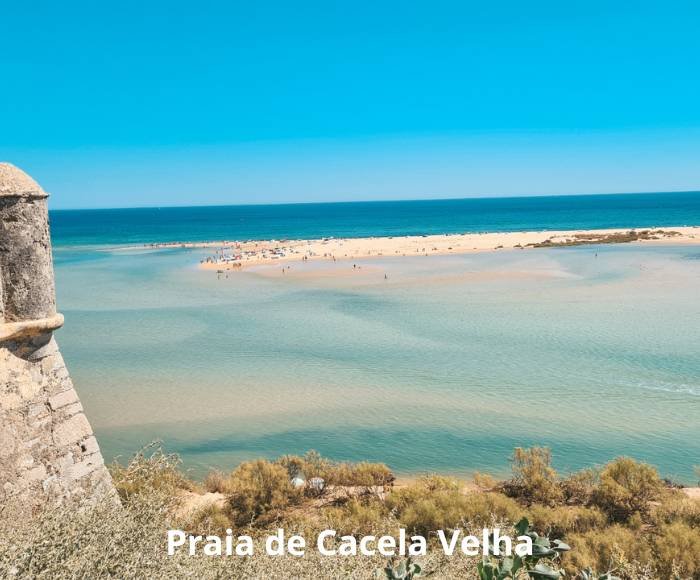
Praia Verde (Castro Marim)
📍 Location: Castro Marim | 🌲 Forest & Beach | 🌡️ Warm Water | 🍽️ Chic Restaurants | 🍃 Natural Shade
Its name means “Green Beach”, and it becomes obvious the moment you arrive. Unlike the classic arid or dune landscapes, Praia Verde stands out thanks to a lush pine forest that gently slopes down almost to the sand. This dense vegetation shelters the beach from the wind and gives the ocean, by reflection, a unique emerald hue.
It’s a beach with a distinctive atmosphere, both sophisticated and deeply natural. The vibe is “boho-chic”, with elegant wooden walkways and renowned beach restaurants (such as the famous Pezinhos n’Areia) nestled beneath the trees. The water here is known to be among the warmest and calmest in the country, making it a place of pure relaxation where stress seems to melt away instantly.
-
Amo-te Olhão’s tip: This is one of the rare beaches in the Algarve where you can enjoy natural shade without an umbrella. Settle at the top of the beach, along the edge of the pine forest, and enjoy the cool shade and the sound of cicadas between swims.
- View on Google Maps : click here.
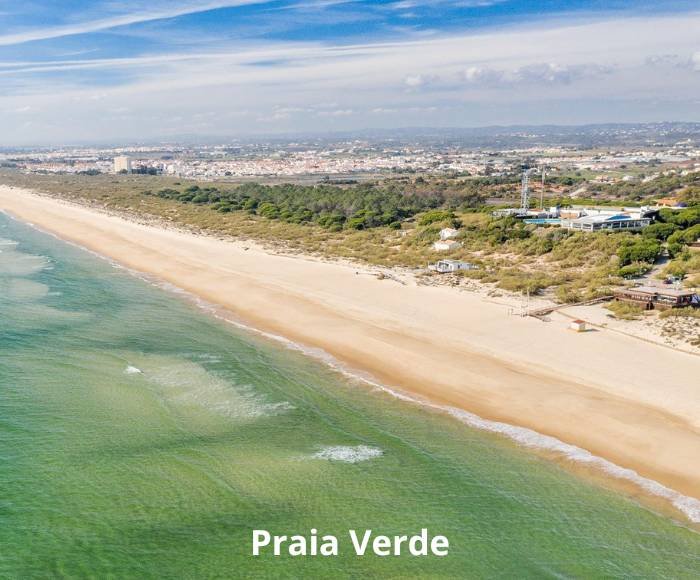
The Islands of Ria Formosa: The Caribbean of Europe
Here, we enter another world — a lagoon archipelago of unreal beauty stretching from Faro to Cacela Velha. This is the realm of the Ria Formosa, one of Portugal’s 7 Natural Wonders. From this point on, the car becomes useless: the journey truly begins at the quay, boarding a ferry or a water taxi.
These barrier islands protect the lagoon from the ocean and offer a landscape unlike anywhere else in Europe: endless stretches of immaculate white sand, washed by crystal-clear waters with turquoise shades that rival the tropics. This is a land without roads, without asphalt and without stress, where life follows the rhythm of tides and boat schedules.
It is also the beating heart of traditional fishing culture. On some islands, such as Culatra, fishing communities live here year-round, preserving a rare and genuine authenticity. From the total isolation of Ilha Deserta to the village atmosphere of Armona, we invite you to discover these floating jewels, accessible only by sea.
Ilha Deserta / Barreta (Faro)
📍 Departure: Faro | 🏝️ Untouched Island | 🧭 Southernmost Point (Cabo) | 🤫 Absolute Silence | 🍽️ Traditional Restaurant
Its name says it all: Ilha Deserta (also known as Barreta) is the only uninhabited island in this archipelago. No houses, no hotels — just sand, dunes, and the ocean. This is the southernmost point of mainland Portugal (Cabo de Santa Maria), where the land truly ends and the sea begins. The water here is exceptionally clear, often considered the purest in the Algarve.
The island offers a refined “Robinson Crusoe” experience. Visitors come here to lose themselves in vast open spaces, walk along wooden boardwalks that protect the fragile dune ecosystem, and enjoy a silence broken only by the sound of the waves. There is just one building on the island: the iconic eco-restaurant Estaminé, fully energy self-sufficient — a true gastronomic oasis in the middle of nowhere.
-
Amo-te Olhão’s tip: Walk all the way to Cabo de Santa Maria (about 20–30 minutes from the pier). You’ll find a driftwood sculpture marking the southernmost point. This is where Atlantic and Mediterranean currents meet, often creating spectacular cross waves.
- View on Google Maps : click here.
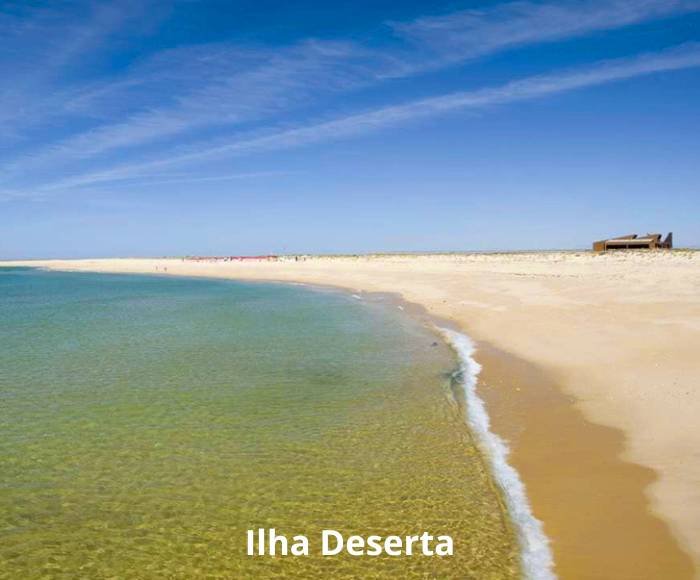
Ilha do Farol (Ria Formosa)
♥ Favourite
📍 Departure: Olhão & Faro | 🗼 Iconic Lighthouse | 🚤 Ferry & Taxi Boat | 🏘️ Sandy Village | 🍹 Lively Bars
Although geographically part of the same sandbank as Culatra, this “island”, Ilha do Farol, has a very distinct identity, dominated by its impressive white lighthouse (the Farol de Santa Maria) guarding the entrance to the lagoon. The arrival is spectacular: access is only by sea, via regular ferries or water taxis departing from the harbours of Olhão and Faro. The 30–45 minute crossing through the maze of the Ria Formosa is already part of the experience.
Once there, the atmosphere feels like an endless holiday. There are no roads, only sandy lanes lined with charming, colourful holiday homes and small flower-filled gardens. On the ocean side, the beach is vast and the water crystal clear. The presence of the large breakwater (the “Barra”) creates interesting currents and offers a degree of shelter, while also being a favourite spot for scenic walks.
-
Amo-te Olhão’s tip: Don’t stay only on the beach! Walk all the way to the end of the long concrete breakwater stretching out into the sea. You’ll be surrounded by the ocean, with open views over the coast and, if you’re lucky, dolphins often spotted offshore.
- View on Google Maps : click here.
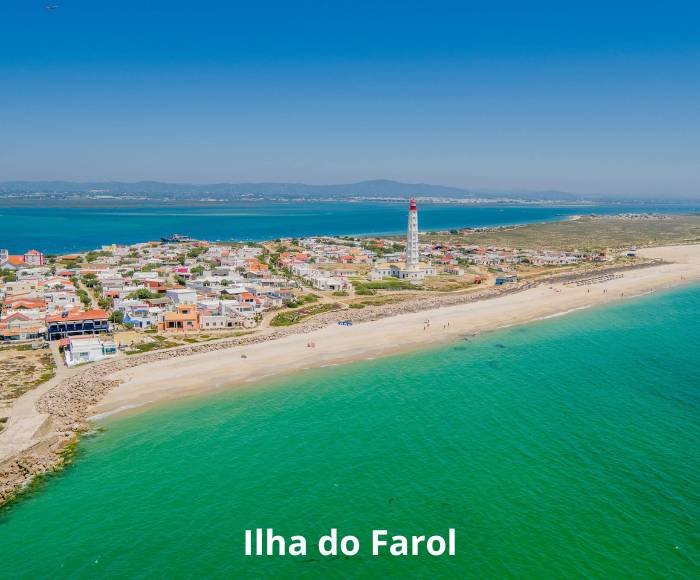
Ilha da Culatra (Olhão)
♥ Favourite
📍 Departure: Olhão | ⚓ Fishing Village | 🐟 Authentic | 🚶 Nature Boardwalk | ⛴️ Direct Ferry
This is the maritime soul of Olhão. Unlike Farol, which is very beach-oriented, Ilha da Culatra is home to a real fishing community that lives here year-round, with its own school, church and active fishing harbour. The island is mainly reached from Olhão (ferry all year) and from Faro (in summer). Arrival is on the lagoon side (Ria), right in the heart of the authentic village, where fishing nets dry in the sun.
To reach the ocean beach, you need to cross the island on foot via a long wooden boardwalk that spans dunes and salt marshes. This 15–20 minute walk is a beautiful immersion into the flora of the Ria Formosa. At the end comes the reward: a vast, wild beach, much quieter than Farol’s, where you truly feel connected to nature.
-
Amo-te Olhão’s tip: If you enjoy walking, do the Culatra ↔ Farol connection along the beach (around 45 minutes to 1 hour with your feet in the sand). Arrive by boat at one stop, walk along the ocean, then catch the boat back from the other stop. It’s the locals’ favourite Sunday walk.
- View on Google Maps: click here.
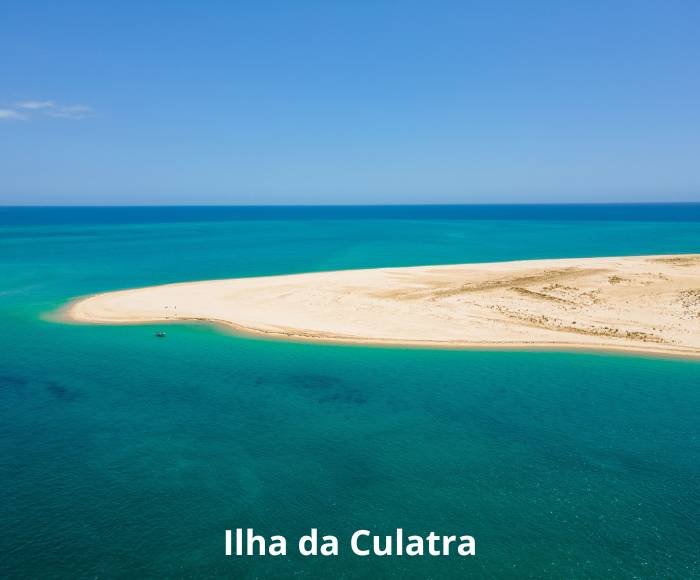
Ilha da Armona (Olhão)
📍 Departure: Olhão | ⏱️ 15-min Ferry | 👨👩👧👦 Family-Friendly | 🦀 Ria & Ocean Sides | 🏘️ Sandy Streets
It is the clear favourite among families from Olhão, as it is the easiest and quickest island to reach. The ferry crossing from Olhão takes just 15 minutes. Ilha da Armona is a long sandy barrier island with a lively holiday village made up of car-free sandy lanes. The atmosphere is friendly and relaxed, almost festive in summer, with plenty of cafés and restaurants right next to the ferry pier.
The island offers two very different swimming experiences. On arrival, the beach on the Ria (lagoon) side is ideal for children: the water is calm, warm and shallow. At low tide, it becomes a huge natural playground for shellfish and crab hunting. To reach the waves, simply cross the village and walk around 15–20 minutes along a wooden boardwalk to the Ocean side, a vast and wild beach that stretches endlessly towards the east.
-
Amo-te Olhão’s tip: If you head to the ocean side, don’t stop where the boardwalk ends, where most people gather. Walk 5 to 10 minutes to the left (east) and you will quickly find yourself alone with the ocean, far from the village buzz.
- View on Google Maps : click here.
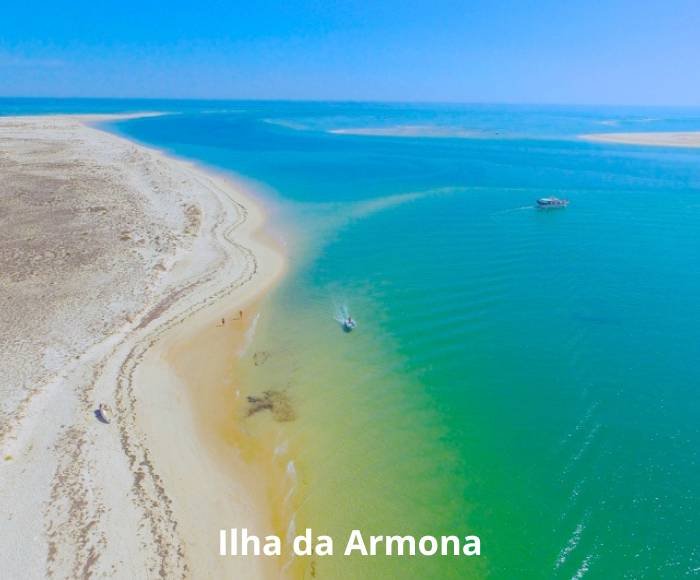
Ilha da Fuzeta (Olhão)
📍 Departure: Fuseta | 🚤 Fast Ferry | 💎 Turquoise Water | 🏊 Natural Pools | 🍹 Beach Bar
Although it is geographically the eastern tip of Armona Island, it is commonly referred to as “Fuseta Island” because it is only accessible from the pier of this village. The boat crossing is very short (around 5–10 minutes) and drops you into a true postcard setting. This is where the Ria Formosa often reveals its most spectacular colours, with shades of blue and green worthy of the Caribbean.
The island is a narrow strip of sand separating the lagoon from the ocean. The pier brings you to the lagoon side, where the water is calm and crystal clear, ideal for snorkelling. Simply cross the dune for a few hundred metres to reach the ocean side, wilder and more open. The atmosphere here is young and relaxed, enlivened by beach bars and water sports.
-
Amo-te Olhão’s tip: Walk east (to the left) towards the “Barra” (the opening to the sea). At low tide, sandbanks appear, creating beautiful natural pools with warm water, perfect for relaxing like in a natural spa.
- See on Google Maps : click here.
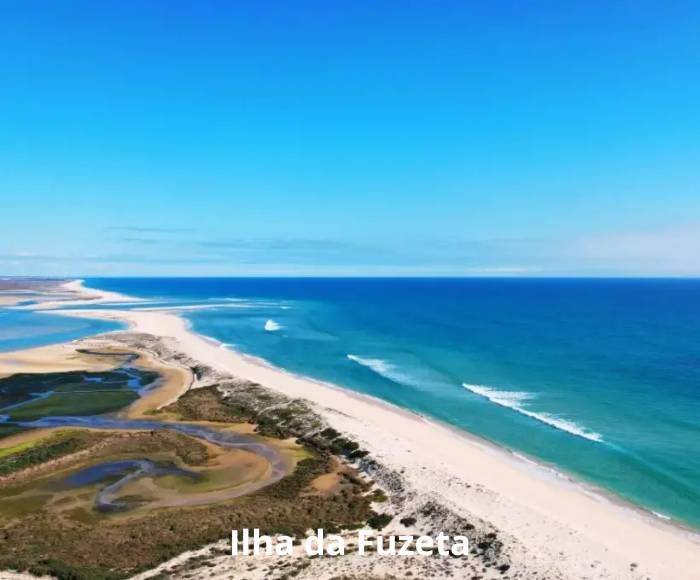
Praia da Terra Estreita (Tavira)
♥ Favourite
📍 Departure: Santa Luzia | 🤫 Secret Spot | 🚤 Short Boat Crossing | 🏖️ Pure Sand | 🍸 Cool Beach Bar
This is the best-kept secret in the Tavira area. Physically located on Ilha de Tavira (between Praia do Barril and Tavira’s main beach), Praia da Terra Estreita (“The Narrow Land”) has its own exclusive boat access from the charming village of Santa Luzia. It’s a stunning beach that often escapes mass tourism, offering the perfect balance between easy access and tranquillity.
The ferry crossing from Santa Luzia takes just 10 minutes and drops you off on a part of the island where the strip of sand is, true to its name, narrower. The atmosphere here is more refined and relaxed than on neighbouring beaches. You’ll usually find an excellent beach bar and exceptionally fine sand. It’s the favourite hideaway for those who want to enjoy the beauty of Ilha de Tavira without the crowds of the campsite or the little tourist train.
-
Amo-te Olhão’s tip: Combine your beach day with a great lunch! Santa Luzia is known as the “Octopus Capital” (Capital do Polvo). Take the boat in the morning, enjoy the beach, then head back to savour a Polvo à Lagareiro in one of the restaurants along the quay facing the lagoon.
- View on Google Maps : click here.
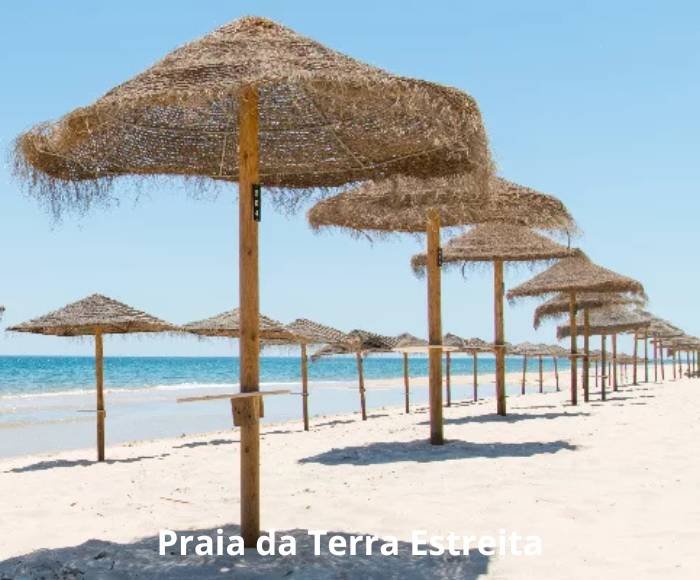
Ilha de Tavira (Tavira)
📍 Departure: Tavira | ⛺ Campsite & Pine Forest | 🚤 Ferry from City Centre | 🍽️ Many Restaurants | 🏄 Water Sports
It is the “Queen” of the Sotavento islands. Easily accessible by ferry from Tavira’s city centre or the “Quatro Águas” pier, Ilha de Tavira is the most developed and lively area of the archipelago. It is the only island with a large campsite shaded by a beautiful pine forest, giving it a unique summer atmosphere that is very family-friendly and relaxed.
Arrival is marked by a wide paved avenue lined with numerous restaurants, bars, and beach shops. It is the ideal place if you enjoy comfort and lively surroundings: sun loungers can be rented, surf lessons are available, or you can simply enjoy a fresh fish lunch facing the ocean. Despite its popularity, the beach is so vast that the white sand stretches as far as the eye can see, making it easy to find your own space.
-
Amo-te Olhão’s tip: If the crowds near the restaurants feel overwhelming, don’t worry. Walk 5 to 10 minutes to the right (west), towards Terra Estreita. The density of visitors drops dramatically, and the wild, peaceful atmosphere typical of the Ria Formosa quickly returns.
- See on Google Maps : click here.
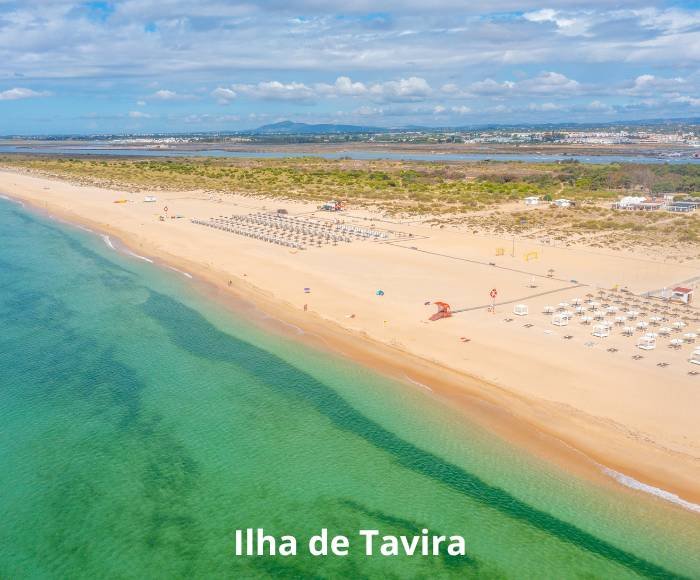
Ilha de Cabanas (Tavira)
📍 Departure: Cabanas de Tavira | 🚤 Express Crossing | 🏖️ Sandbank | 🐚 Shells | 🌅 Village Views
Facing the village of Cabanas de Tavira, this island is a narrow strip of white sand stretching for 7 kilometres. The separation from the mainland is very slim here: the crossing in a small converted fishing boat takes just a few minutes, barely enough time to cross the Ria Formosa channel. At low tide, you might almost feel tempted to swim across — but the currents can be strong!
Once you step onto the wooden jetty, a short walk over the dune reveals an immense, unspoilt beach. Unlike Tavira or Armona, there are no houses here at all — just a single, solitary beach café-bar. This is the realm of calm and wide open spaces. The water is particularly warm, and the sand is often rich in razor clams and cockles, to the delight of amateur shellfish gatherers.
-
Amo-te Olhão’s tip: This is an island best enjoyed on foot. Walk east (to the left) and you will reach the lagoon inlet near Cacela Velha. But don’t forget to look back as well: the view of the white façades of Cabanas village from the beach, with colourful fishing boats in the foreground, is truly charming.
- See on Google Maps: click here.
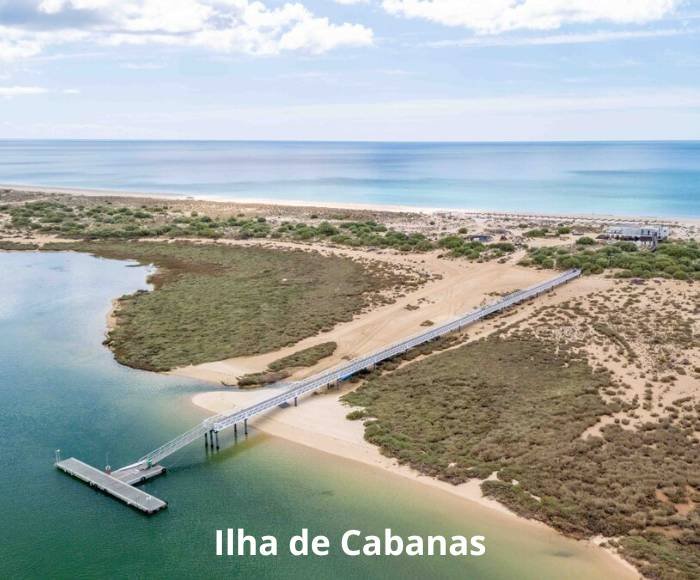
Olhão’s Local Beaches: Hidden Ria Secrets (No Ferry Needed)
Olhão is inseparable from its sandy guardians: the iconic islands of Armona, Culatra and Farol. They line the horizon from the waterfront and are the primary destination for most visitors in search of the open ocean. However, local life is not limited to these boat crossings alone, and sometimes it is simply pleasant to enjoy the water without depending on ferry schedules.
For those who prefer to stay on solid ground, the options are fewer but full of charm. To the west, the vast Praia de Faro (already mentioned in the previous section) remains the quickest way to reach the Atlantic by car. To the east of Olhão, however, the coastline reveals more discreet and intimate treasures. Here, there are no crashing waves, but rather calm waters that move to the slow, soothing rhythm of the tides.
This section focuses on these family-friendly alternatives that are directly accessible from the mainland: Praia dos Cavacos, quietly hidden among pine trees, and the urban beach of Fuseta (Ria side). These are the go-to spots for locals seeking a quick swim or a relaxed family Sunday, offering immediate contact with the rich and ever-changing nature of the Ria Formosa — without ever leaving dry land.
🚢 Feeling like heading out to the islands after all?
If the call of Armona, Culatra or Farol is too strong to resist, forget about paper timetables! Amo-te Olhão makes your stay easier by simplifying crossings like never before.
📱 NEXTFERRY APP: find your next ferry in one click!
With the NextFerry app, instantly find the next available departure and easily add it to your phone so it’s always within reach. Practical, fast, and designed to enhance your experience in Olhão.
👉 Access the NextFerry App
📅 View the dedicated Ferry Timetables page
Praia dos Cavacos (Olhão)
📍 Location: Between Olhão and Fuseta | 🧺 Picnic Area | 🌅 Sunset Spot | 🦀 Nature | ⚠️ High Tide Required
This is a well-kept secret, tucked away in the heart of the salt marshes, halfway between Olhão and Fuseta. Praia dos Cavacos is not a classic white-sand beach, but an authentic and wild lagoon bay. It is highly appreciated by locals for its absolute calm and its open views over the distant islands, offering a peaceful alternative far from tourist crowds and ferry queues.
However, there is one golden rule here: check the tide times! This spot can only be fully enjoyed at high tide. When the water fills the bay, it becomes a calm bathing area, with water noticeably warmer than the open ocean. At low tide, the sea retreats far away, revealing nutrient-rich mudflats that are not suitable for swimming (although locals often use them for therapeutic mud baths!).
-
Amo-te Olhão’s tip: This is undoubtedly one of the best sunset aperitif spots in the area. With no visual obstacles, the sky ignites over the Ria Formosa and reflects on the calm waters (or the moist mudflats), creating an unforgettable panoramic spectacle.
- View on Google Maps: click here.
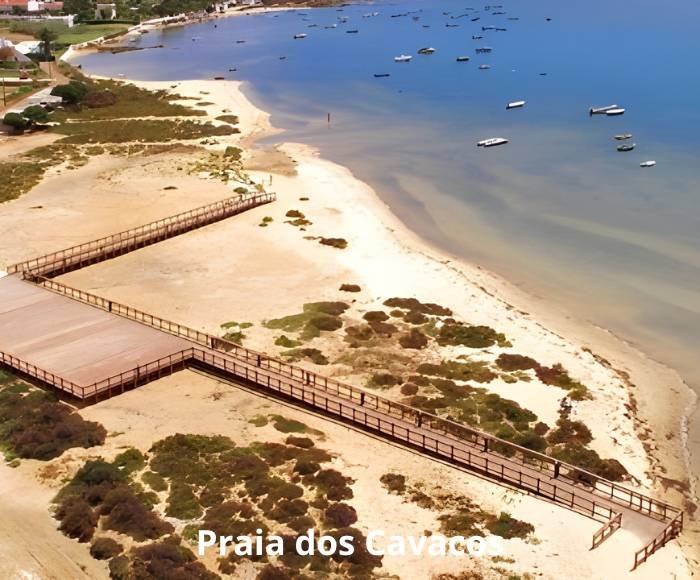
Praia da Fuseta – Ria (Fuseta)
📍 Location: Fuseta (Village) | 👶 Baby-Friendly | 🏘️ Town Centre | ♿ Accessible | 🛶 Kayak & Paddle
Be careful not to confuse it with the island (ocean side)! Here, we are talking about the beach located within the village of Fuseta, on the edge of the lagoon (often called “Praia dos Tesos”). It is the ultimate family beach. Easily accessible on foot, with a stroller or a wheelchair, it offers a wide stretch of golden sand washed by calm, wave-free waters, protected by the distant dune barrier.
It is the ideal and safe playground for parents with young children. The water is crystal clear and stays shallow for a long way out. Supervised in summer, it has all amenities close at hand (showers, cafés) just a few metres away. It is also a very popular spot to try Stand-Up Paddle or kayaking along the peaceful channels of the Ria Formosa.
-
Amo-te Olhão’s tip: Come in the morning to enjoy the Fuseta market right next door, buy some fresh fruit, then end the morning with a relaxing swim here before the sun gets too strong. This is Portuguese “dolce vita” at its best.
- View on Google Maps : click here.
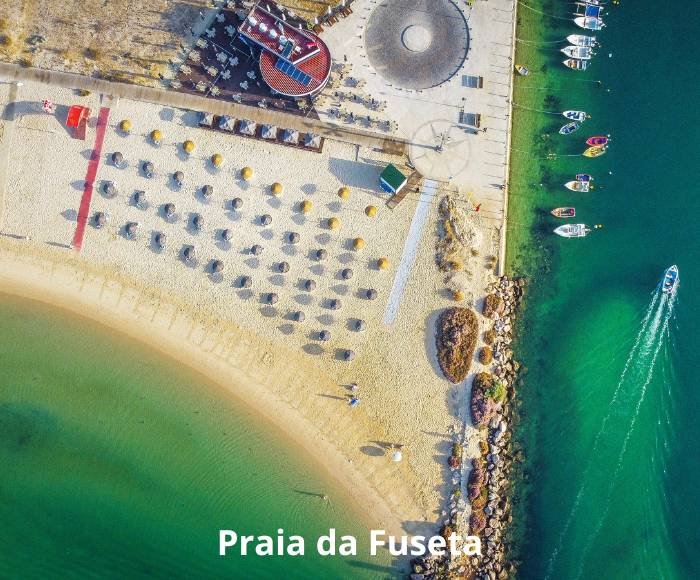
Quality, safety and services: why Algarve beaches are exemplary
The Algarve is not only beautiful — it is clean and safe. Once again this year, the region confirms its status as a national leader with 85 beaches awarded the “Blue Flag” (Bandeira Azul). This demanding international label guarantees water quality, swimming safety, environmental management and well-maintained facilities. The municipality of Albufeira leads the way with 25 awarded beaches, followed by Vila do Bispo and Loulé.
To make everyday planning easier, we strongly recommend downloading the official Info Praia app (available on iOS and Android). It’s the Portuguese beach equivalent of Waze: it provides real-time information on flag colour, water quality, crowd levels and available facilities (showers, accessible access). An essential tool for choosing the right beach in the morning!
Good to Know: The Reality of Summer in the Algarve
The Algarve is a victim of its own success. In July and August, it’s important to be realistic: the most famous beaches are extremely busy. Parking can become a real challenge (especially at Marinha, Camilo or Benagil). Our advice: arrive before 9:00 am or after 5:00 pm. On long beaches (Falésia, Tavira, Meia Praia), don’t hesitate to walk 10 extra minutes away from the main access points — you will always find space to lay down your towel.
In terms of comfort, most supervised beaches offer sunbed and parasol rentals (expect between €15 and €25 per day depending on the location). As for swimming, remember that you are in the Atlantic Ocean! The water is refreshing (often between 19 °C and 21 °C on the western coast). However, the further east you go (Sotavento / Olhão / Tavira), the warmer the water becomes thanks to Mediterranean influence and the lagoons, sometimes reaching 24 °C.
🌊 The crucial importance of tides:
In the Algarve, tides change everything. A wide beach can shrink to a narrow strip of sand at high tide, while low tide can reveal fantastic natural pools (such as at Manta Rota or Rocha) or allow crossings on foot (Cacela Velha). Always check the tide timetable before heading out!
Which Beach for Which Traveller?
Still hesitating among all these options? Here is our quick selection to help you go straight to the right choice, depending on your traveller profile:
-
👨👩👧👦 For Families: Choose beaches with calm waters and full facilities such as Praia da Luz (Lagos), Praia da Falésia (Vilamoura side for easy access), or the unmissable Ilha de Tavira.
-
🛑 To Escape the Crowds: Peace and quiet must be earned! Go for beaches with more challenging access such as Praia da Amália (West Coast) or the secret Praia do Carvalho. A bit of walking is always rewarded with tranquillity.
-
🏄 For Surfers: Head to the wild West Coast! Praia da Arrifana is a must, as well as the legendary Praia do Amado, known for its consistent waves.
-
❤️ For Romantics: Nothing beats a sunset over the rock formations of Praia da Dona Ana or an off-season stroll down the steps of Praia do Camilo.
-
🛶 For Explorers: Rent a kayak or SUP at Praia da Marinha or Benagil. It’s the only way to discover dozens of sea caves that are inaccessible on foot.
A Pact with Nature: Protected Beaches and Preservation in the Algarve
These landscapes we love so much are fragile. The dunes, clay cliffs and the lagoon ecosystems of the Ria Formosa are under significant pressure. For the Algarve to remain magical, the rule is simple: leave nothing behind, except your footprints.
Take your litter with you (and even pick up any you see), stick to the wooden boardwalks to avoid trampling the dune vegetation, do not disturb marine life (starfish, crabs) or birds, and of course, fires are strictly prohibited. Let’s protect this paradise together.
The Algarve, an ocean of possibilities for every traveller
From the raw, untamed power of the Costa Vicentina to the crystal-clear waters of the Ria Formosa islands, we have travelled together along more than 200 kilometres of coastline. This journey proves one thing: there is not just one Algarve, but many Algarves.
Whether you are a surfer chasing adrenaline beneath dark cliffs, a family seeking the gentle warmth of lagoon waters, or an explorer of sea caves and hidden coves, this region offers a geological and emotional diversity unlike anywhere else in Europe. Every beach has its own soul, its own light and its own story.
This guide was created with heart and real local experience, and it is meant to help you step off the beaten path. Don’t settle for the beach closest to your hotel. Dare to take that little train, walk down that hidden staircase, or cross by boat. It is often at the very end of the road that the most beautiful memories are made.
Enjoy the sea, and savour every sunset!
The Amo-te Olhão team.

Instagram
Follow @amoteolhao
Follow us on social media to keep up-to-date with latest news, discounts and events.